
The payment plan was supposed to be the off-plan sweetener: pay in slices while the tower goes up, because the tower does not exist yet. Then the towers got finished, and the plans did not go away.
Anyone searching for ready properties on payment plan in Dubai is asking whether that is a real market or a marketing line. It is real, and it is measurable: of 394 finished projects in our Dubai catalogue, 84 still publish an instalment plan – one in five. And their terms are not the off-plan terms with the construction removed. They are better. The median first payment on a finished home with a plan is 10%, half the 20% that off-plan asks, and 20 of the 84 ask for nothing at all on day one.
That inversion deserves a moment. The building that exists, that you can walk through, that could demand cash because it is standing there, asks for less up front than the one that is still a hole in the ground.
One in five finished projects still sells on instalments
A plan on a finished home works differently, and the strings show it. Ready-stock plans look like 0/60/40 or 0/25/75: nothing down, a schedule of instalments, and a final slice at transfer. There is no construction to link payments to, so the schedule is simply time.
What a buyer gets is the thing a mortgage offers, minus the bank: no salary certificate, no valuation, no approval committee. What a buyer gives up is the bank's paperwork discipline, so the contract carries all the weight. The title transfer usually happens at the end of the schedule, not the beginning, and that single clause changes what you own in the meantime. Read it before admiring the zero.
How to read the plan string
Every published plan compresses to two or three numbers. 20/40/40 means 20% down, 40% in instalments during construction, 40% at handover. Two numbers, like 30/70, skip the middle: 30% down, 70% on completion.
Across the 499 Dubai projects that publish one, there are 87 distinct structures. Nearly every one of them is described, somewhere in its marketing, as flexible.
Flexible!
The other 1,170 projects in the catalogue, 67% of the market, publish no numbers at all. Their plan is "Click for details." A plan you have to ask for is a plan that can differ by buyer, by week, and by how the sales office reads you – which is worth knowing before you treat any single quoted plan as the price of entry.
There is no standard plan
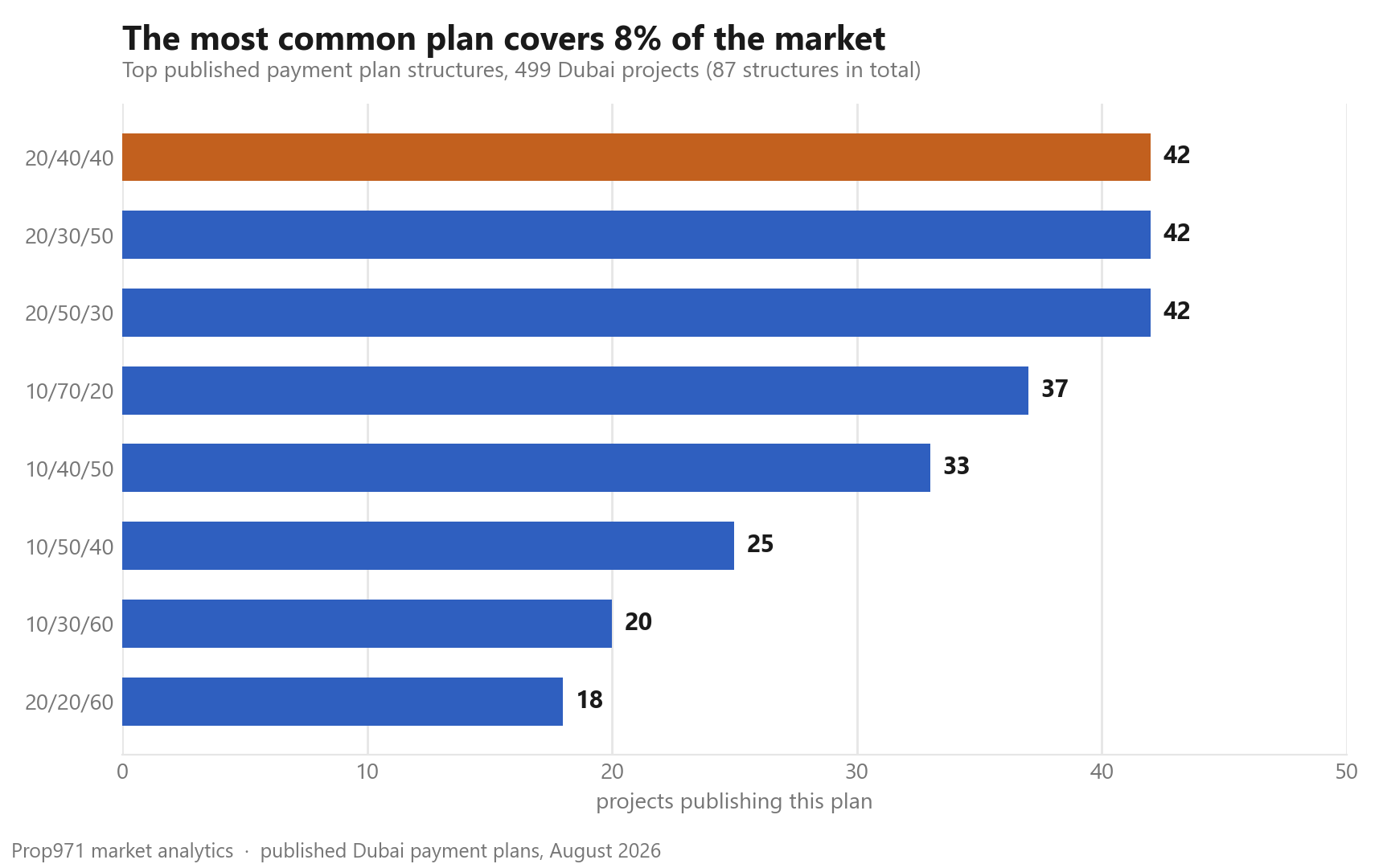
The most common plan in Dubai, 20/40/40, covers 8.4% of the market. That is what passes for a standard. Three structures tie at the top with 42 projects each, and the shape scatters from there into 87 variants.
| Plan | Projects | Down | During construction | At handover |
|---|---|---|---|---|
| 20/40/40 | 42 | 20% | 40% | 40% |
| 20/30/50 | 42 | 20% | 30% | 50% |
| 20/50/30 | 42 | 20% | 50% | 30% |
| 10/70/20 | 37 | 10% | 70% | 20% |
| 10/40/50 | 33 | 10% | 40% | 50% |
| 10/50/40 | 25 | 10% | 50% | 40% |
| 10/30/60 | 20 | 10% | 30% | 60% |
| 20/20/60 | 18 | 20% | 20% | 60% |
| Zero-down plans (all forms) | 24 | 0% | instalments + balance at or after handover | |
The practical consequence: a plan is not a market convention you can assume, it is a per-project term you have to read. Two projects at the same price in the same district can want your money in completely different years.
The down payment: 20% is the rule, 10% is the top end
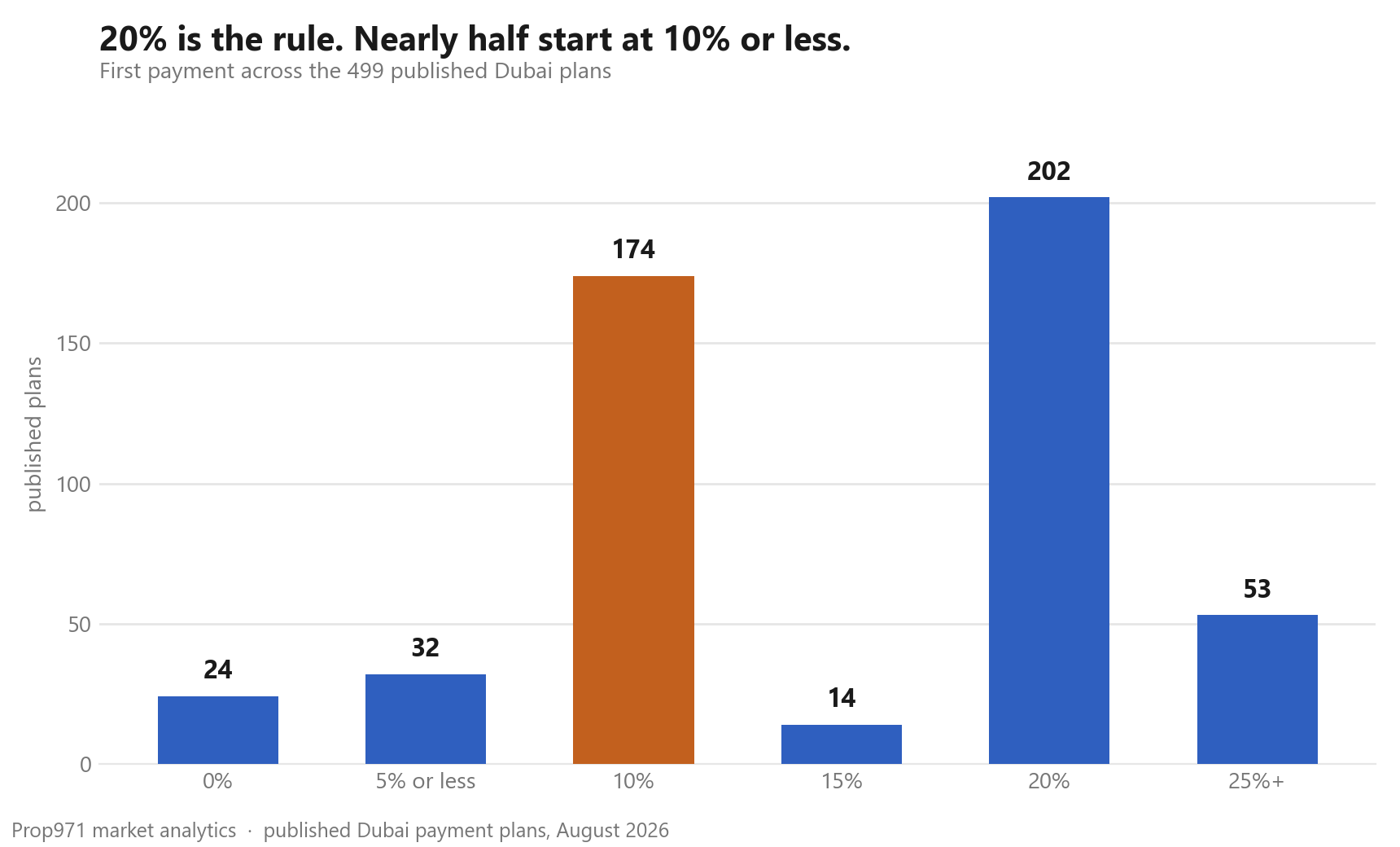
The median down payment is 20%, and 20% is also the single most common ask, on 202 of the 499 plans. But the distribution has a heavy low tail: 46% of published plans start at 10% or less, including 24 that start at zero.
Where that low tail lives is the surprise. Split the plans by entry price and the pattern inverts the way you would guess:
- Under AED 1M: median down payment 20%
- AED 1M to 2M: median 20%
- AED 2M and above: median 10%
The most expensive stock asks the smallest share up front. Affordable projects, whose buyers presumably have the least spare cash, ask double. The likely mechanics are unsentimental: the premium end is where developers compete hardest for investors, and a low entry is the loudest thing you can print. Whatever the reason, the buyer maths is what it is – a 10% start on AED 2.5M is AED 250k, a 20% start on AED 900k is AED 180k, and the gap between the two buyers is smaller than the price tags suggest.
Half the price arrives with the keys, or later
Across the 499 plans, just under half leave 50% or more of the price to handover or beyond, and 28% leave 60% or more. The instalments you pay while the crane is up are, in most plans, the smaller half of the deal.
A growing sliver stretches past the keys entirely: 61 projects publish post-handover instalments – about one in ten of the full schedules we hold. Most run two to three years after completion. The most patient one runs 120 months past handover: collect the keys, then finish paying a decade later.
None of this is free money, and one registry-computed number keeps the whole subject honest: off-plan property trades at roughly a 28% premium per square foot over finished stock in Dubai. Some of that premium is the newer building. Some of it is the plan itself, priced in. A payment plan is credit, the developer is the lender, and lenders are paid – just in the price rather than in an interest line.
Two checks protect the money, and they are boring on purpose. First, instalments on an off-plan plan should go to the project's escrow account, the regulated account a developer can only draw against construction progress – verifiable through the Dubai Land Department before you sign. Second, on a ready-stock plan, confirm when title transfers, because "pay over four years" can mean owning from day one or owning at the final instalment, and those are different purchases. The ownership framework itself is set out on the UAE government portal.
Comparing two plans in five minutes
Strings hide timing, so convert both plans to the same question: how much have I paid by the day I can use or rent the home? A 20/30/50 and a 10/70/20 look like cousins; by handover day one has taken 50% of your money and the other 80%. If the home is an investment, every dirham paid before the keys is a dirham earning nothing – which is also why the rental yields conversation and the plan conversation are the same conversation.
Then check what the plan is attached to. A generous split on a project you would not buy in cash is still that project. The off-plan versus ready trade does not disappear because the instalments are pretty, and the buying process still runs through the same registration steps either way.
The tedious part is that plans live scattered across hundreds of project pages and rotate with developer promotions. That is dull work to track by hand, which is why the current crop sits in one place on our offers page, and every project page on the site prints its published split next to the price.
FAQ
Can you buy a ready property on a payment plan in Dubai?
Yes. 84 of the 394 finished projects in our Dubai catalogue publish an instalment plan, about one in five. Their median first payment is 10%, half the off-plan norm, and 20 of the 84 ask nothing on day one, with the balance spread over a schedule that often ends at title transfer.
What is the typical down payment on a Dubai payment plan?
The median is 20%, which is also the most common single figure, on 202 of 499 published plans. The spread matters more than the median: 46% of plans start at 10% or less, and projects priced above AED 2M ask a median of just 10%, half what cheaper projects ask.
What does a plan like 20/40/40 mean?
20% down, 40% in instalments during construction, and 40% at handover. Two-number plans such as 30/70 skip the middle: 30% down and 70% on completion. Dubai currently has 87 distinct published structures, so read the specific project's string rather than assuming a convention.
What is a post-handover payment plan?
A schedule that keeps running after you receive the keys. 61 Dubai projects publish one, typically two to three years past completion, and the longest published schedule stretches 120 months after handover. You occupy or rent the home while still paying the developer.
Is a payment plan cheaper than a mortgage?
It is simpler, not automatically cheaper. Off-plan stock trades at roughly a 28% premium per square foot over finished stock in Dubai, and part of that premium is the financing baked into the price. A plan charges you in the price; a mortgage charges you in an interest line. Compare the total paid, not the monthly.
Where do payment plan instalments actually go?
For off-plan purchases, into the project's escrow account, which the developer can only draw against construction progress. That account is verifiable through the Dubai Land Department before signing. For ready-stock plans there is no escrow requirement, so the contract and the title-transfer clause carry the protection.
References
Figures in this article are computed from official UAE property transaction records (DLD) via Prop971 market analytics, including transactions up to 26 August 2026, alongside the payment plans published on Prop971's Dubai project catalogue as of 29 August 2026.


