
Hamdan Bin Mohammed Street is the busiest address in Abu Dhabi and one of the quietest property markets in it. Across the twelve months to 10 September 2026, the central districts the street runs through recorded 57 registered sales. The emirate as a whole recorded 27,811.
That is not a market in trouble. It is a map doing exactly what it was designed to do, and knowing the shape of it saves a buyer weeks of looking in the wrong postcode.
The four streets, and the 0.2%
Hamdan Bin Mohammed Street is known to nearly everyone simply as Hamdan Street. It runs across the north of Abu Dhabi island through Al Markaziyah, the commercial core, and it is paralleled by three others that carry most of the city's daily traffic: Electra Street, renamed Zayed the First Street but still called Electra by almost everybody; Najda Street; and Khalifa Street.
Between them these four carry the banks, the electronics shops, the older residential towers and a large share of Abu Dhabi's working day.
They carry almost none of its property transactions. The central districts they pass through, taken together, accounted for 0.2% of everything registered in the emirate over the year. Al Muntazah led that group with 17 sales. Central District managed 12, Al Bateen 11, Al Danah 6.
For context, a single tower's launch elsewhere in the emirate can clear more than that in a weekend.
The reason is not demand. It is eligibility. Abu Dhabi sells freehold to foreign buyers inside designated investment zones, defined by the Department of Municipalities and Transport, and central Abu Dhabi island is largely outside them. A search that starts on Hamdan Street is a search for a place to live and work, which is a fair thing to want. A search for something to buy has to move about ten kilometres.
Where Abu Dhabi's 27,811 sales actually happened
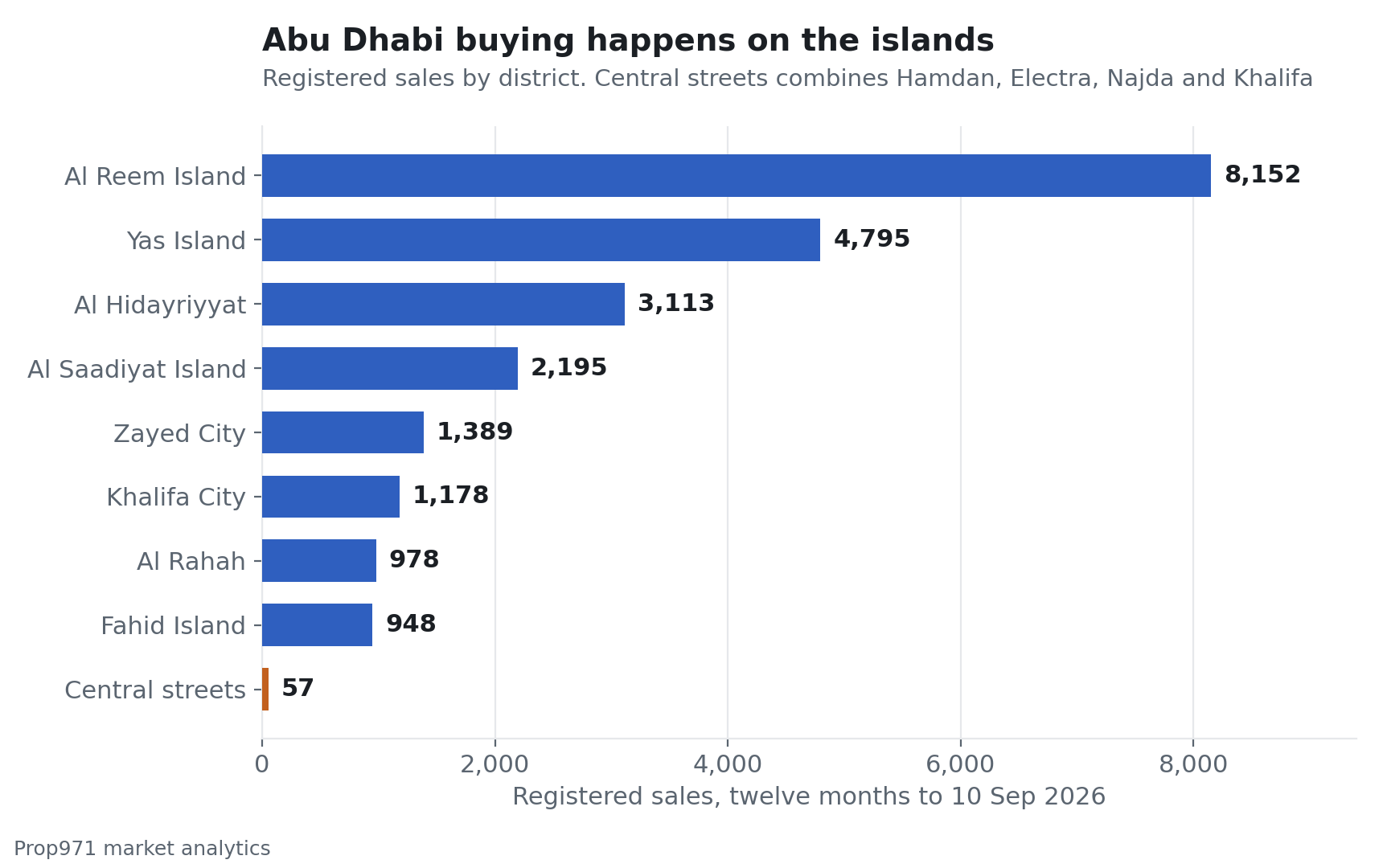
The investment zones took 21,683 sales, or 78% of the emirate's total. The concentration inside that is steeper still.
Al Reem Island alone recorded 8,152, which is 29% of everything sold in Abu Dhabi. Yas Island followed with 4,795, then Al Hidayriyyat with 3,113 and Al Saadiyat Island with 2,195. Zayed City took 1,389, Khalifa City 1,178, Al Rahah 978 and Fahid Island 948.
Two islands, Reem and Yas, accounted for 47% of the emirate between them. If you have ten hours to spend researching Abu Dhabi, spending five of them on those two is a defensible allocation.
What each zone costs per square foot
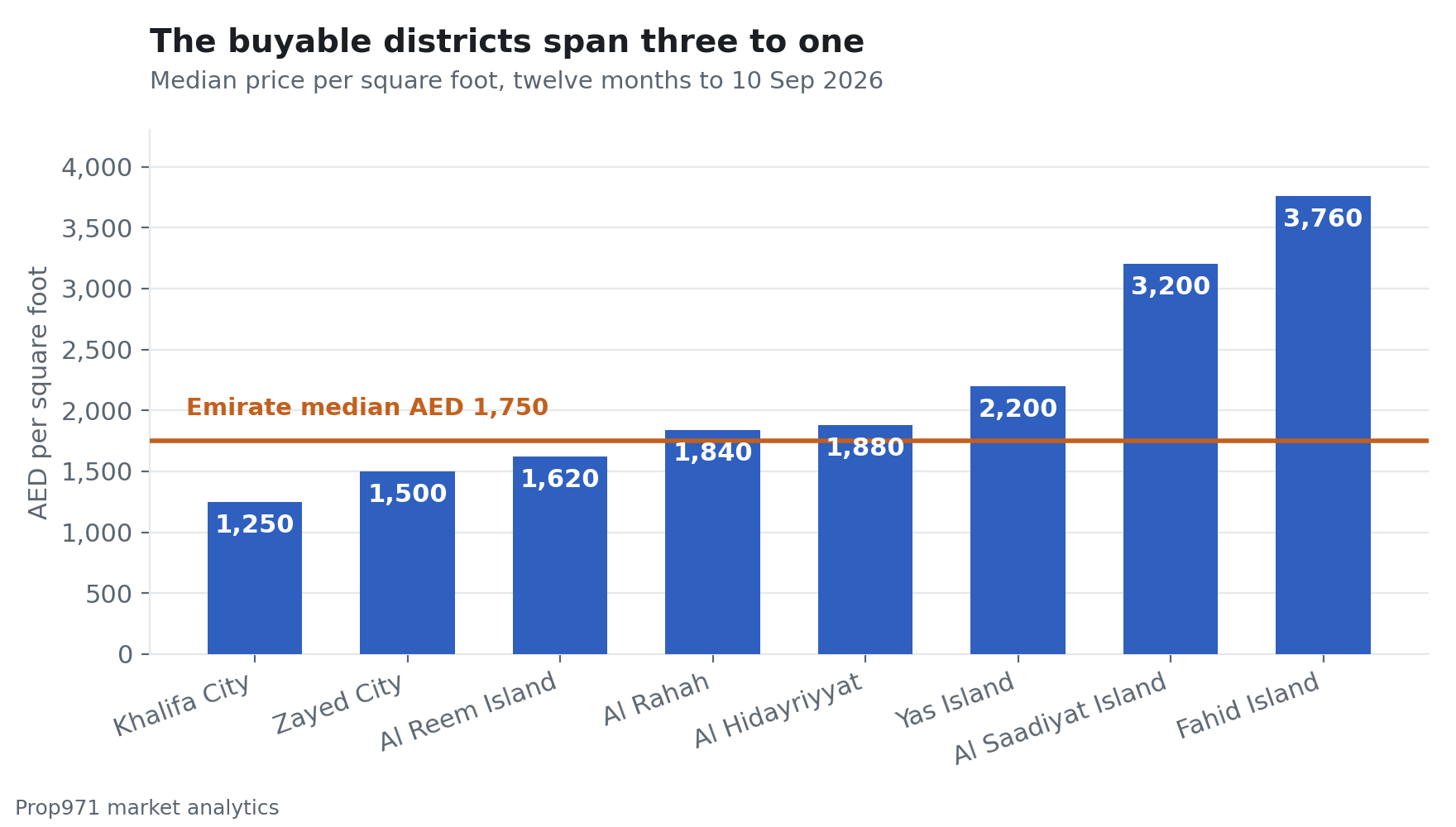
The emirate's median came in at AED 1,750 per square foot. The range behind that number is what matters.
Khalifa City was the cheapest of the major zones at AED 1,250. Zayed City followed at AED 1,500, then Al Reem Island at AED 1,620, Al Rahah at AED 1,840 and Al Hidayriyyat at AED 1,880. Yas Island reached AED 2,200, Al Saadiyat Island AED 3,200 and Fahid Island AED 3,760.
| District | Registered sales | Share of emirate | Median per sq ft |
|---|---|---|---|
| Al Reem Island | 8,152 | 29.3% | AED 1,620 |
| Yas Island | 4,795 | 17.2% | AED 2,200 |
| Al Hidayriyyat | 3,113 | 11.2% | AED 1,880 |
| Al Saadiyat Island | 2,195 | 7.9% | AED 3,200 |
| Zayed City | 1,389 | 5.0% | AED 1,500 |
| Khalifa City | 1,178 | 4.2% | AED 1,250 |
| Al Rahah | 978 | 3.5% | AED 1,840 |
| Fahid Island | 948 | 3.4% | AED 3,760 |
| Central streets (Hamdan, Electra, Najda, Khalifa) | 57 | 0.2% | too few sales |
Three things fall out of that list. The busiest district is not the most expensive one: Al Reem sits below the emirate median while doing 29% of the volume. The most expensive districts are the smallest by count, which is what you would expect from waterfront stock. And the gap between the cheapest and dearest major zone is threefold, so "the Abu Dhabi price" is a number with very little meaning until you name a district.
Our guide to the best areas to invest in Abu Dhabi takes those districts one at a time, and the Khalifa City guide covers the cheapest of them in detail.
What a flat on Al Reem Island actually costs
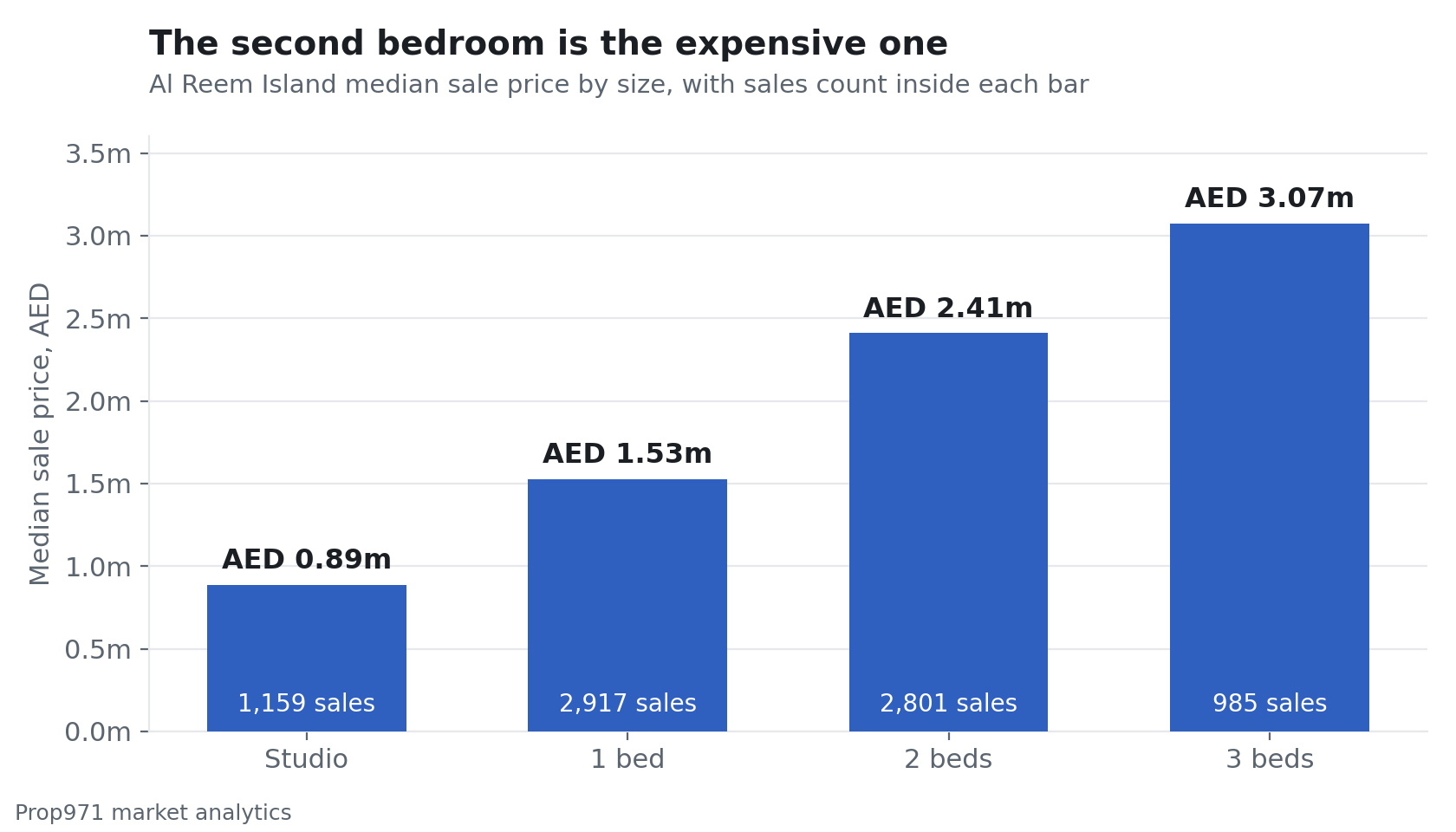
Volume is what makes a median trustworthy, and the Al Reem Island area page has it.
A studio sold at a median of AED 888,000 across 1,159 sales. A one-bedroom apartment ran AED 1,527,000 over 2,917 sales, the single most traded size in the emirate. Two-bedroom apartments came in at AED 2,410,000 across 2,801 sales, and three-bedroom apartments at AED 3,074,000 over 985.
The step from a one-bedroom to a two-bedroom costs about AED 880,000. The step from two to three costs about AED 664,000. The expensive bedroom is the second one, which is the opposite of how most buyers budget, and it is worth checking against your own shortlist before you decide which size to stretch for.
Four in five sales were off-plan
80.4% of everything registered in Abu Dhabi over the year was off-plan rather than finished property. Inside the investment zones the figure was almost identical at 80.9%.
That tells you what kind of market this is. Abu Dhabi is not mainly trading its existing housing stock between owners; it is selling buildings that do not exist yet. For a buyer, the practical consequences are ordinary but easy to forget: the price is set by a payment plan rather than a mortgage valuation, the handover date is part of the product, and the thing you can walk around today is a rendering.
It also explains the Hamdan Street number from a different direction. Central Abu Dhabi is finished. There is nothing left to launch there, and in a market where four out of five sales are launches, a finished district barely registers.
Payment plans and launch incentives move faster than prices do, and the current ones sit on our offers page.
What this means if you started on Hamdan Street
Nothing about the above makes central Abu Dhabi a bad place. It makes it a place you rent in, work in, shop in and drive through.
If the reason you searched was to buy, the practical version of the advice is short. Decide first whether you want volume and liquidity or waterfront scarcity, because Abu Dhabi separates those cleanly. Reem and Yas give you the former: thousands of comparable sales a year, which means a median you can trust and an exit with buyers in it. Saadiyat and Fahid give you the latter at roughly twice the rate per square foot.
Then check the payment plan before the price, because in a market that is 80% off-plan the plan is the price.
The Abu Dhabi off-plan guide covers how those launches work, and the Al Raha guide looks at one of the mainland zones in the table above.
FAQ
Can you buy property on Hamdan Bin Mohammed Street?
Mostly not as a foreign freehold buyer. Central Abu Dhabi island sits largely outside the designated investment zones where freehold is sold to non-nationals, which is why the districts the street runs through recorded 57 registered sales in the twelve months to 10 September 2026, against 27,811 across the emirate.
Where is Hamdan Bin Mohammed Street?
It crosses the north of Abu Dhabi island through Al Markaziyah, the commercial core, running parallel to Electra Street, Najda Street and Khalifa Street. Almost everyone calls it Hamdan Street.
Where does most Abu Dhabi property actually sell?
In the investment zones, which took 21,683 sales or 78% of the emirate's total. Al Reem Island alone recorded 8,152 sales, or 29%, followed by Yas Island with 4,795, Al Hidayriyyat with 3,113 and Al Saadiyat Island with 2,195.
How much does an apartment cost on Al Reem Island?
The median studio sold at AED 888,000, a one-bedroom at AED 1,527,000, a two-bedroom at AED 2,410,000 and a three-bedroom at AED 3,074,000, across 7,862 sales of those four sizes in the twelve months to 10 September 2026.
Which Abu Dhabi district is cheapest per square foot?
Of the major zones, Khalifa City at a median of AED 1,250 per square foot, against an emirate median of AED 1,750. Zayed City followed at AED 1,500 and Al Reem Island at AED 1,620.
Is Abu Dhabi property mostly off-plan?
Yes. 80.4% of registered sales over the year were off-plan rather than finished property, and 80.9% inside the investment zones. The Abu Dhabi Real Estate Centre publishes the registration rules that govern those sales.
References
Figures in this article are computed from official UAE property transaction records (DLD, ADREC) via Prop971 market analytics, including transactions up to 10 September 2026.


