

One Dubai district sold more homes last year than Downtown and Dubai Marina combined, and most buyers cannot place it on a map. Dubai South property changed hands 14,285 times in the last 12 months, up 46% on the year before. Downtown Dubai managed 2,773 sales in the same period. Dubai Marina managed 3,289.
This is the quiet part of the Dubai market: the busiest district is not the famous one.
The district nobody can name
Part of the confusion is that it has three names. Buyers and brokers say Dubai South. The airport authority zone is Dubai World Central. The land registry files transactions under Madinat Al Mataar, which translates as Airport City, which is at least honest about what the area is for.
It sits at the far south-western end of the city, wrapped around Al Maktoum International Airport and the former Expo site. That location is the entire investment case. Dubai Airports is building out Al Maktoum to take the traffic currently landing at the main airport, and the residential districts nearest it have been selling into that expectation for two years.
Whether the airport arrives on schedule is not something a transaction record can tell you. What it can tell you is that buyers are not waiting to find out.
Volume is the whole story
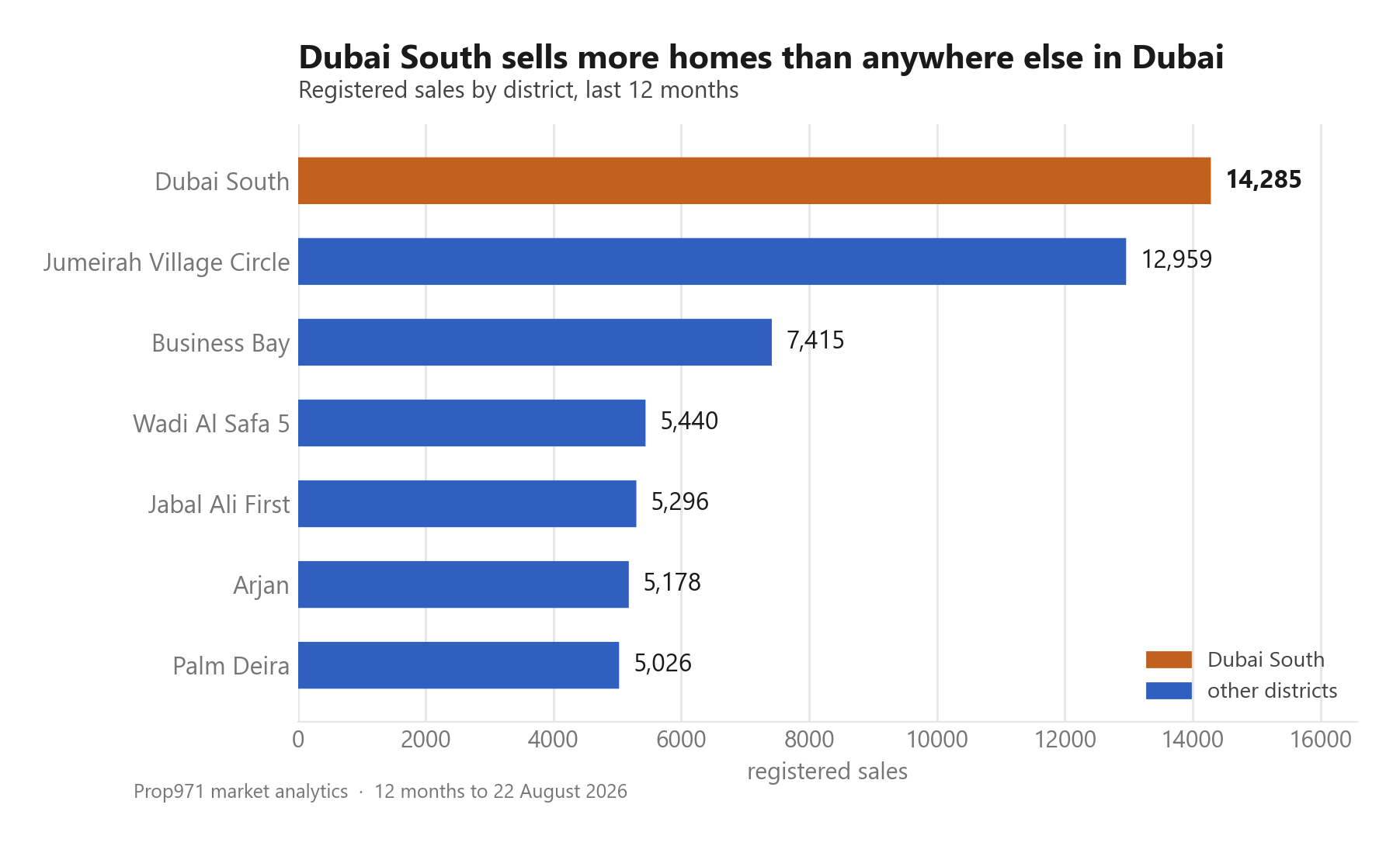
Fourteen thousand sales in a district is not a trend, it is a construction programme. 94% of those sales were off-plan, against 76% across Dubai as a whole. Only 6% of what changed hands in Dubai South last year was a building somebody could walk into.
Compare that with the districts below it in the pecking order. [Jumeirah Village Circle](/area/dubai/jumeirah-village-circle), the closest rival on volume, ran 12,959 sales at 66% off-plan. Business Bay ran 7,415 at 68%. Dubai Marina, the most famous address on the list, ran 3,289 at 26% off-plan, which is what a finished district looks like when it trades: mostly resale, mostly ready.
Dubai South is the opposite of a finished district. It is a district being sold before it exists.
The median price fell 32%. Nothing got cheaper.
Here is where the headline number lies to you.
The median Dubai South sale was AED 1.05m in the last 12 months, down from AED 1.54m the year before. A 32% drop in the typical price paid. Read that on its own and you would conclude the district had a bad year.
Price per square foot went up 4.4% over the same period, from AED 1,583 to AED 1,653.
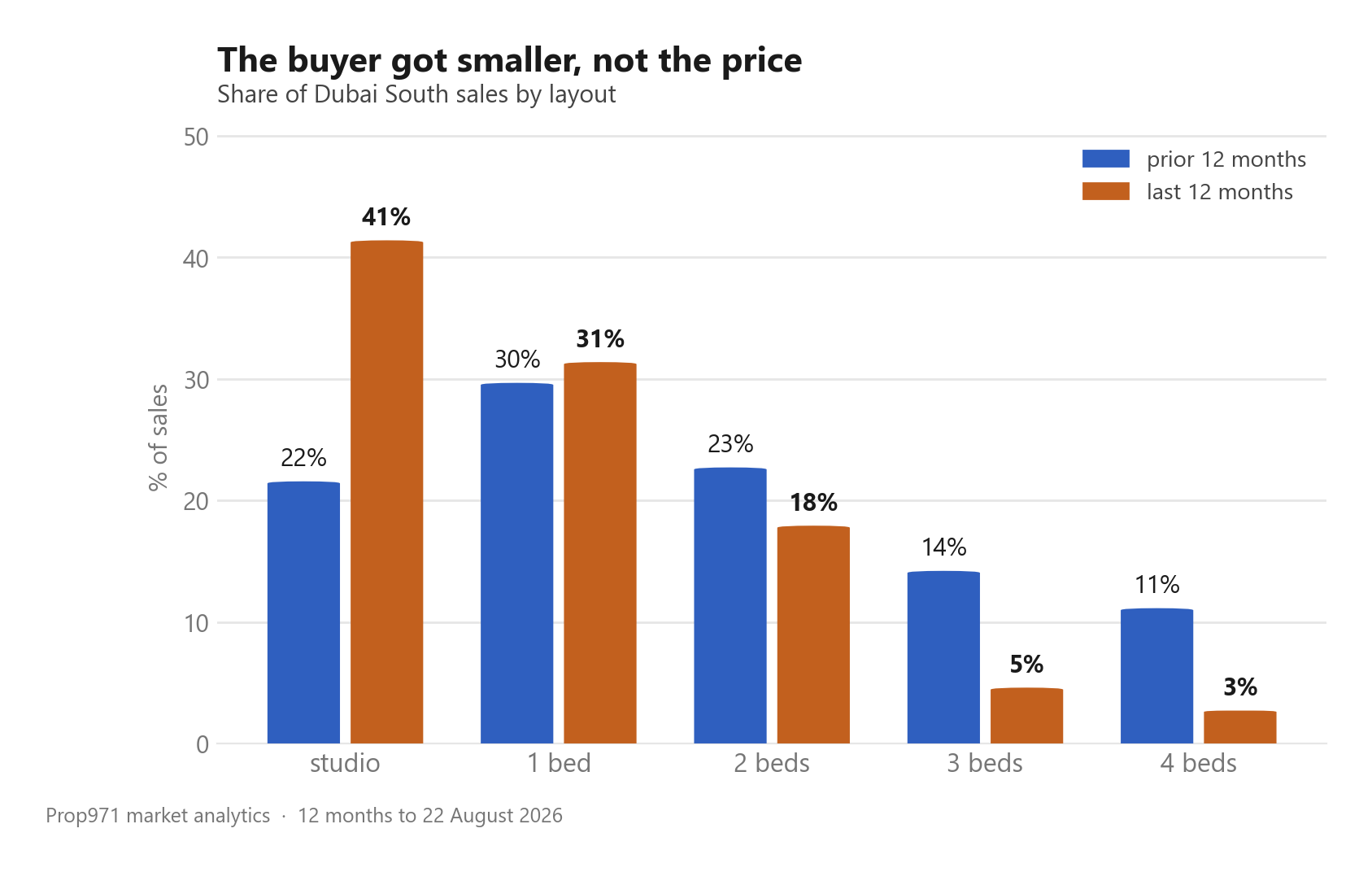
Both numbers are correct. What changed was not the price of space, it was the size of what people bought. Studios were 21.6% of sales last year. They are 41.4% now. Three-bedroom units fell from 14.2% of sales to 4.6%, and four-beds from 11.1% to 2.7%. The median unit shrank from 980 square feet to 723.
Like for like, prices rose. A studio went from AED 610k to AED 650k, up 4.5% per square foot. A one-bed went from AED 1.12m to AED 1.17m, up 4.2%. Two-beds were the exception, down 8.6% per square foot, which is what happens when a layout goes out of fashion in a district selling this much stock at once.
So the market did not correct. The buyer got smaller.
What each layout actually costs
The per-square-foot numbers invert the way people expect. Studios trade at AED 1,753 per square foot in Dubai South. Four-beds trade at AED 1,250. The smallest unit carries the highest price per foot and the largest carries the lowest, which is the standard shape of an investor-led district: small units are priced off rental demand, big ones off what an end user will stretch to.
| Layout | Share of sales | Median price | Median per sq ft | Typical rent | Gross yield |
|---|---|---|---|---|---|
| Studio | 41% | AED 650,000 | AED 1,753 | AED 40,000 | 6.2% |
| 1 bed | 31% | AED 1,171,000 | AED 1,584 | AED 54,000 | 4.6% |
| 2 beds | 18% | AED 1,865,000 | AED 1,551 | AED 85,000 | 4.6% |
| 3 beds | 5% | AED 2,746,444 | AED 1,551 | AED 110,000 | 4.0% |
| 4 beds | 3% | AED 4,336,467 | AED 1,250 | AED 150,000 | 3.5% |
Studios are 41% of the sales and 6.2% gross yield on today's rents. That is comfortably above the roughly 5.3% median across Dubai districts with meaningful volume. One-beds and two-beds both sit at 4.6%, three-beds at 4.0%.
One caveat that matters more than any of these figures: those rents are what ready units earn today, and 94% of these sales are not ready. The yield is a forecast wearing the costume of a measurement. Rents in a district about to receive several thousand new apartments are the least safe number on this page. You can pressure-test your own assumptions in the ROI calculator rather than accepting a district-level average.
What 94% off-plan actually means
This section has no jokes in it.
Buying off-plan in Dubai means paying in instalments for a unit that does not exist yet, against a title that is registered as an Oqood, the pre-handover ownership record, rather than a title deed. Your money goes into an escrow account tied to that specific project, and the developer draws from it against construction milestones verified by the Dubai Land Department.
That structure protects you well. It does not protect you from everything, and in a district running this much simultaneous supply, three things are worth checking before signing anything.
Completion percentage, not launch date. The registry publishes a construction progress figure per project. A project at 8% complete with a handover date 18 months out is making a claim you can check.
How much supply lands the same quarter you do. Fourteen thousand sales a year become handovers eventually. If several thousand units complete in the same six months you take keys, you are competing with all of them for the same tenants, at exactly the moment your yield stops being hypothetical.
Whether the payment plan survives a delay. Post-handover plans are common here. Read what happens to the schedule if handover moves, because the schedule and the handover date are not always tied together.
If a plan sounds unusually generous, the discount is usually somewhere in the terms rather than the price. Current developer terms across the market are listed on our offers page.
Abu Dhabi runs a different play
The Abu Dhabi market does not repeat this pattern, which is worth knowing if you are choosing between the two emirates.
Abu Dhabi's busiest district, Al Reem Island, recorded 8,446 sales in the last 12 months at AED 1,606 per square foot and 73% off-plan. Yas Island ran 4,940 at AED 2,174 and 89% off-plan. Both are island districts with defined boundaries and a finite amount of land, so supply arrives in waves that end.
Dubai South has no such boundary. It is desert with a masterplan, which means the supply constraint is developer appetite rather than geography. That is a different risk to underwrite: in Abu Dhabi you are forecasting demand against a fixed denominator, and here you are forecasting both.
Median Abu Dhabi sale price across the emirate was AED 2.4m against Dubai's AED 1.31m, so the two markets are not competing for the same buyer at the same budget anyway.
Who this district is actually for
The buyer profile is clear from the mix. Forty-one percent studios and thirty-one percent one-beds is not a family district in its current phase. It is a yield district, priced for investors buying the cheapest entry point in a growth corridor, at a median of AED 1.05m.
If you want a finished building, a tenant already in it and a rent you can verify, this is the wrong district and [Dubai Marina](/area/dubai/dubai-marina) or [Business Bay](/area/dubai/business-bay) will serve you better at a higher price per foot. If you are buying the airport thesis, you are early, which is the only time being early is worth anything.
Current listings and price movement for the district sit on the [Dubai South area page](/area/dubai/dubai-south), and the broader off-plan pipeline is on [new projects](/new-projects).
FAQ
Is Dubai South a good investment?
On the numbers, Dubai South offers the highest transaction volume of any Dubai district and gross yields around 6.2% on studios, above the roughly 5.3% district median. The risk is that 94% of sales are off-plan, so both the building and the rent are forecasts rather than facts at the point you pay.
What is the difference between Dubai South and Madinat Al Mataar?
They are the same place. Madinat Al Mataar is the name the land registry files transactions under, Dubai World Central is the airport and free-zone designation, and Dubai South is the name used in marketing and by brokers.
How much does an apartment in Dubai South cost?
The median sale over the last 12 months was AED 1.05m. By layout, the median studio traded at AED 650k, a one-bed at AED 1.17m and a two-bed at AED 1.87m.
Why did the median price in Dubai South fall while prices went up?
Because the mix changed. Studios rose from 21.6% to 41.4% of sales and larger units fell away, so the typical unit shrank from 980 square feet to 723. Measured per square foot, prices rose 4.4%.
Is Dubai South freehold for foreign buyers?
Yes. The district is a designated freehold area, so non-UAE nationals can buy and hold full ownership, the same as in Dubai Marina or Business Bay.
References
Figures in this article are computed from official UAE property transaction records (DLD, ADREC) via Prop971 market analytics, including transactions up to 22 August 2026.


