
A studio and a two bedroom are not the same investment in different sizes. Over the last twelve months a Dubai studio returned 7.0% gross on its purchase price. A two bedroom returned 3.7%.
That is not a small edge. It is nearly double, on the same street, in the same building, from the same tenant pool. And it runs against the instinct most buyers arrive with, which is that a bigger unit is a better asset.
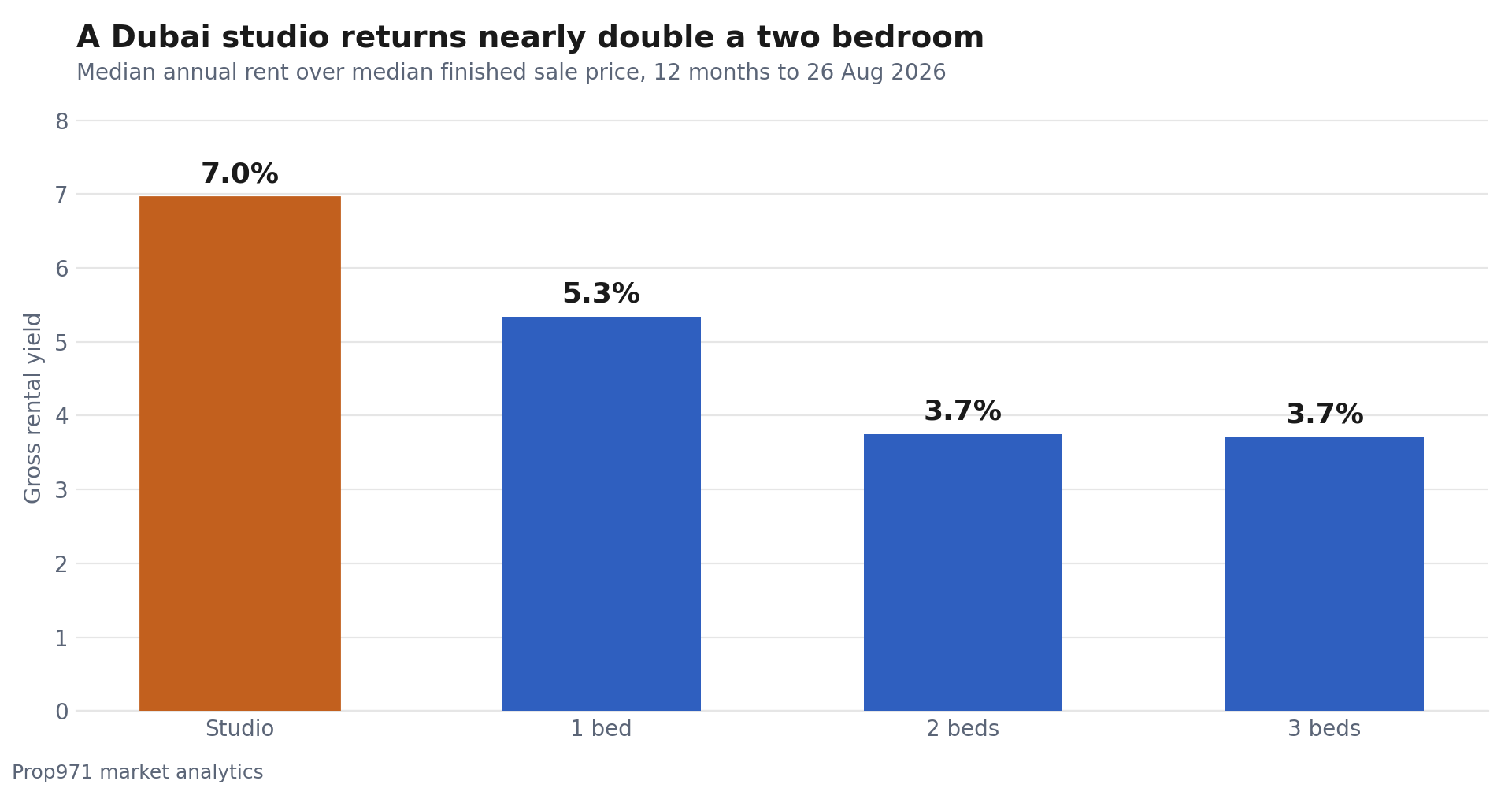
Note where the ladder stops. Studio to one bedroom costs you 1.6 points. One bedroom to two costs another 1.6. Two to three costs nothing at all, because both sit at 3.7%. Past the second bedroom you are no longer trading yield for size. You are just buying size.
Rent does not scale the way price does
The reason is arithmetic, and it is worth seeing directly rather than taking on trust.
Move from a studio to a two bedroom in Dubai and the purchase price multiplies by 3.5. The rent multiplies by 1.9. Go all the way to three bedrooms and the price is 6.0 times the studio while the rent is 3.2 times.
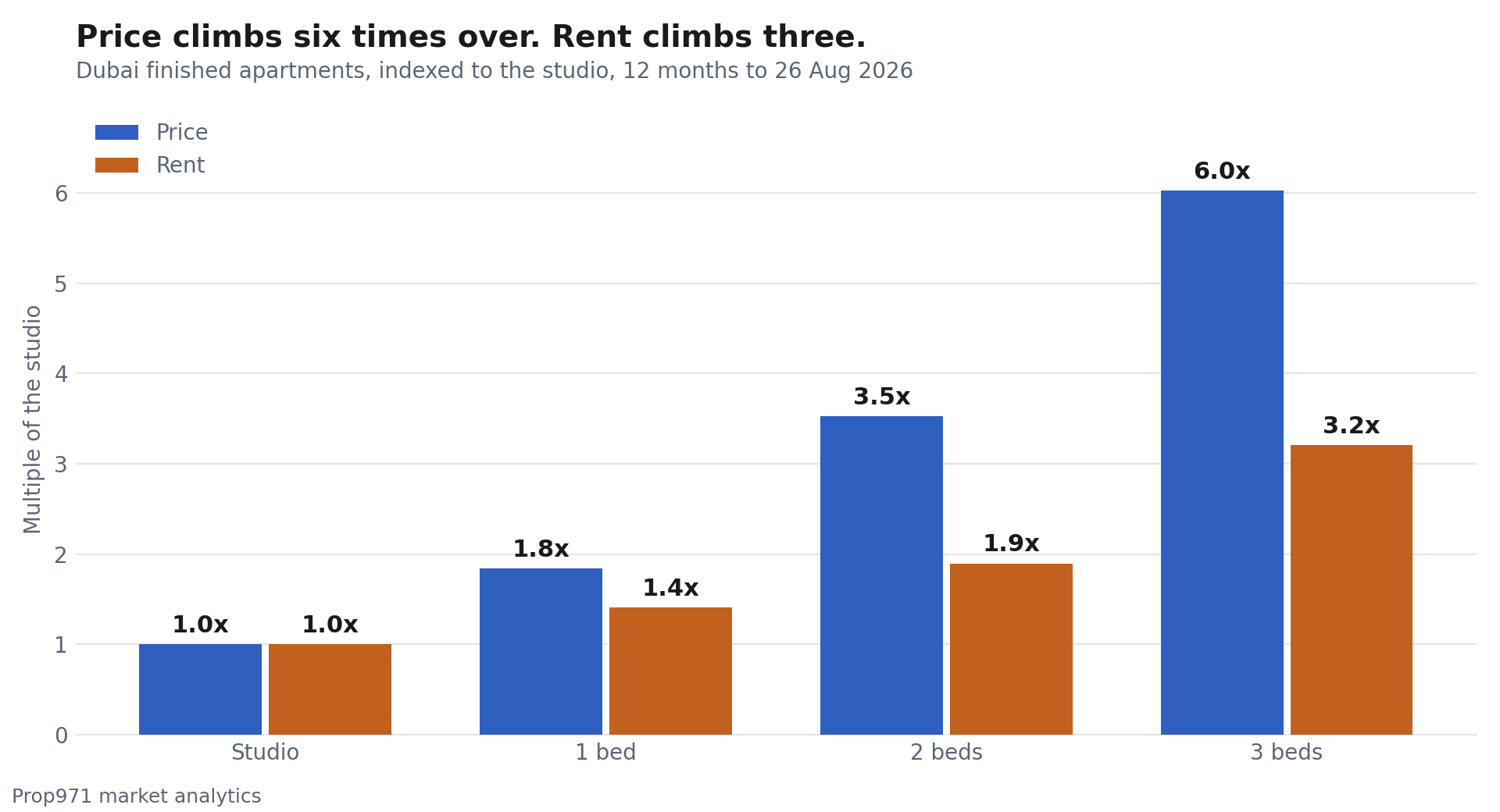
Two lines diverging is the whole story. A yield is one divided by the other, so when the denominator climbs at twice the speed of the numerator, the yield has to fall. Every bedroom you add is sold to you at a premium the rental market does not pay.
Premium!
Here is the same fact in money. The median finished two bedroom sold for AED 1,975,000 and lets for AED 74,000 a year. That budget also buys 3.5 studios at the median studio price of AED 560,000, and 3.5 studios let for about AED 137,500 a year. Same capital. AED 63,500 more rent, an 86% increase, for the identical outlay.
Nobody should read that as a recommendation to go and buy three and a half studios. Three tenancies means three renewals, three void periods, three sets of service charges and three chances for something to break in August. The point is narrower and more useful: the size premium is a real cost with a measurable number attached, and most buyers never see the number. Whether the extra bedroom is worth 3.2 points of yield is a decision. It should be a decision, and not a default.
Where the yield is, and where the marketing is
Bedroom count is only half of it. The same one bedroom, bought in a different part of Dubai, returns a very different number.
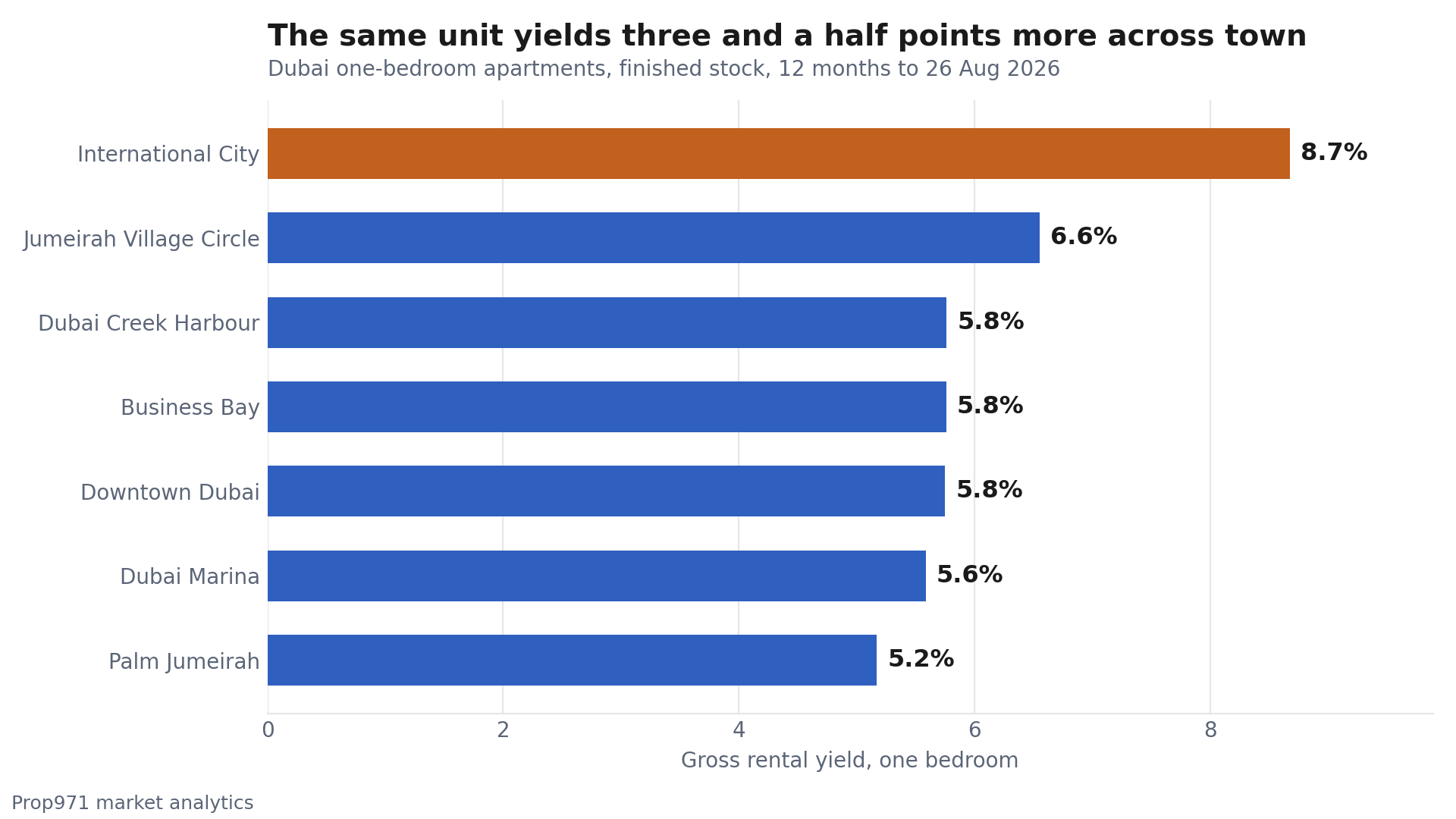
International City returns 8.7% on a one bedroom. Palm Jumeirah returns 5.2%. That is a 3.5 point spread on the same unit type, and it maps almost perfectly onto how desirable each address sounds. The best-known addresses cluster tightly between 5.2% and 5.8%: Palm Jumeirah, Dubai Marina, Downtown and Business Bay are separated by six tenths of a point between them.
This is not a market failure. Prestige addresses trade at a premium because buyers want to own them, and capital growth is a return too, just not one that shows up in a rent cheque. A 5.2% yield on the Palm is a considered trade, not a mistake.
But it does mean the yield question and the address question pull in opposite directions, and only one of them gets marketed to you. A sales centre will tell you about the address. The yield you have to work out yourself, from a rent figure and a price figure that are published in different places by different people and never printed side by side. That is dull work, and dull work is what people skip, which is why our ROI calculator holds both figures for a district and a bedroom count in the same view.
Abu Dhabi has the same shape and a lower ceiling
Run the identical calculation in Abu Dhabi and the pattern survives: smaller units yield more, and the curve flattens after two bedrooms. What changes is the level. Abu Dhabi yields sit roughly two points below Dubai at every bedroom count. A studio there returns about 5% where Dubai returns 7.0%, and a two bedroom about 3% against 3.7%.
The practical translation is blunt. An Abu Dhabi studio yields less than a Dubai one bedroom. If income is the objective, the emirate is a bigger lever than the bedroom count, and it is the one buyers tend to treat as fixed.
Abu Dhabi's rent record is far thinner than Dubai's, so those are directional figures rather than precise ones, and no district-level Abu Dhabi number belongs in this article at all.
What gross yield leaves out
Every figure above is gross, and gross is doing a lot of work in that phrase.
Service charges come out first, billed per square foot and payable whether or not the unit is let. Small units are not automatically cheaper here: a tower with a pool, a gym and a concierge spreads those costs across its floor area, so a studio in a high-specification building can carry a service charge that eats a larger share of its rent than a two bedroom in a plainer one. Then agency commission on each new tenancy, the tenancy registration fee, maintenance, and any month the unit sits empty. A single void month costs about 8% of the annual rent on its own.
None of that changes the ranking. The studio still beats the two bedroom after costs, because a 3.2 point head start is wide enough to absorb them. It does change the number you should plan around, and the honest way to use a gross yield is as a comparison tool between options rather than as a forecast of what lands in your account.
Two things are worth checking before you commit to any specific unit. Ask for the building's actual service charge per square foot, in writing, rather than an estimate. And if the unit is off-plan, remember that everything above is computed on finished stock: an off-plan price cannot be let, and the rent you eventually collect will be set by the market on handover day, not by today's. Confirm the project is registered and that your instalments go into its escrow account, the regulated account a developer can only draw against construction progress. That is verifiable in advance through the Dubai Land Department, and it is the check that most protects the money.
The short version
If income is the goal, the order of the levers is: emirate first, then district, then bedroom count, then the specific building. Most buyers work that list backwards, starting with a building they were shown and ending with a yield they discover afterwards.
The numbers to carry: 7.0% for a Dubai studio, 5.3% for a one bedroom, 3.7% for anything larger. Cross-check any specific unit against those before deciding it is a good deal, and if it comes in materially below, the address had better be the reason.
FAQ
What is a good rental yield in Dubai?
Anything at or above 6% gross is strong for Dubai, and the market-wide numbers give you the benchmark to judge against: studios average 7.0%, one bedrooms 5.3%, and two and three bedrooms both 3.7%. Compare a specific unit against its own bedroom count rather than against a single citywide figure, because the four sizes are effectively four different markets.
Which property type has the highest rental yield in Dubai?
Studios, by a wide margin, at 7.0% gross against 3.7% for two and three bedrooms. The gap exists because purchase prices rise roughly twice as fast as rents as units get larger: a two bedroom costs 3.5 times a studio but lets for only 1.9 times as much.
Which Dubai area has the best rental yield?
Among established districts, International City leads on one-bedroom apartments at 8.7% gross, followed by Jumeirah Village Circle at 6.6%. The best-known addresses cluster lower and close together, between 5.2% and 5.8%, which is the price of the address rather than a fault in the asset.
Is rental yield higher in Dubai or Abu Dhabi?
Dubai, by roughly two percentage points at every bedroom count. An Abu Dhabi studio returns about 5% gross where a Dubai studio returns 7.0%, which means an Abu Dhabi studio yields less than a Dubai one bedroom.
Does gross rental yield include service charges?
No. Gross yield is annual rent divided by purchase price, before service charges, agency commission, tenancy registration, maintenance and void periods. Net yield after those costs is typically one to two points lower, and a single empty month costs about 8% of the annual rent by itself.
How do you calculate rental yield on a Dubai property?
Divide the annual rent by the purchase price and multiply by 100. A studio bought at AED 560,000 letting at AED 39,000 gives 39,000 divided by 560,000, or 7.0% gross. Use a finished-property price rather than an off-plan one, since an off-plan unit cannot be let until handover.
References
Figures in this article are computed from official UAE property transaction records (DLD, ADREC) via Prop971 market analytics, including transactions up to 26 August 2026.


