
Half of everything sold in Dubai Production City last year went for under a million dirhams. Across Dubai as a whole, only a third did.
That is the short version of why people search this district. It is one of the few places left inside the city where the entry price still starts with a four, and the transaction record backs that up rather than a brochure. Over the last twelve months the median apartment sold at AED 950k, working out at AED 1,334 per square foot. The Dubai-wide apartment median over the same period was AED 1,260,000 at AED 1,730 per square foot.
So the district trades about 23% below the city on a per-square-foot basis. That is the headline, and it is real. What is more interesting is what sits underneath it, because the discount is not evenly spread. It depends almost entirely on whether the building you are buying has been built yet.
The finished building is the cheap one
Split the district's sales into finished property and off-plan and the two halves barely look like the same market.
Finished apartments changed hands at a median of AED 1,003 per square foot. Off-plan sold at AED 1,396. That is a 39% premium for the version that does not exist yet, against a Dubai-wide off-plan premium of 28% over the same period.
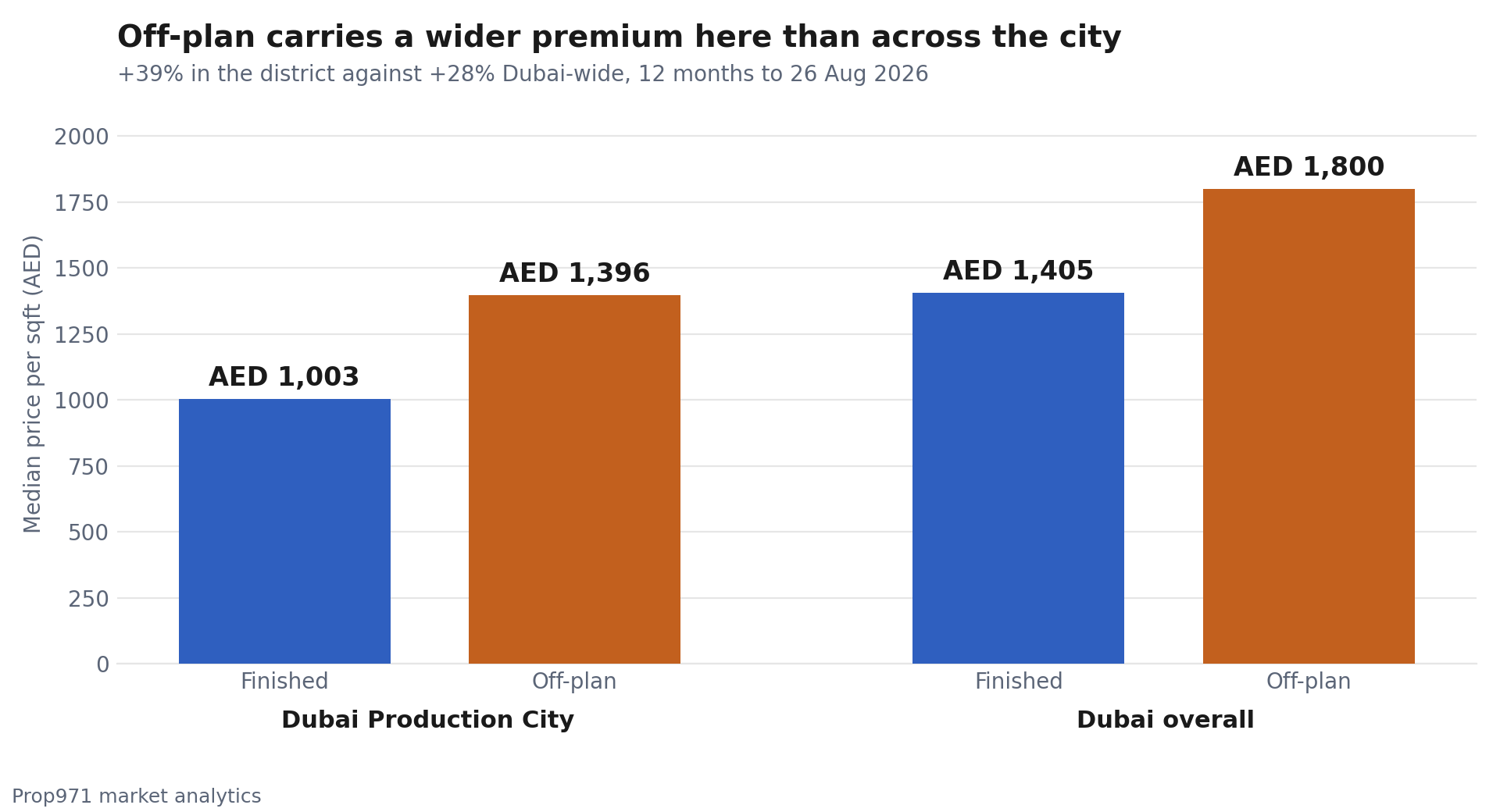
In headline price the gap is wider still. The median finished apartment sold for AED 555k. The median off-plan apartment sold for AED 1,074,600, close to double.
Two honest caveats before anyone reads that as free money. The finished stock is smaller, at a median of 623 square feet against 774 for off-plan, and it is older, which is most of what a per-square-foot gap measures anywhere. And the split is almost exactly a new-versus-resale split: of the 1,566 sales, the 1,191 off-plan ones were all first sales from a developer and the 375 finished ones were all resales.
Still, the shape of it is unusual enough to be worth saying plainly. In most of Dubai the finished building carries a premium for existing. Here it is the discount.
There is a practical consequence to that. Off-plan was 76% of everything registered in the district over the year, so the cheaper half of this market is also the smaller half, and it is the half that does not get launch events, brochures or a sales centre. A buyer working from what is being marketed will mostly be shown the expensive side of a 39% gap. Finding the other side means going looking for it.
Where the entry point actually is
A quarter of the district's sales came in under AED 659k. Ten percent came in under AED 482k. Those are not launch teasers, they are prices that were registered.
The clearest number for anyone actually shopping is the finished one-bedroom: a median of AED 600k for 641 square feet, or AED 863 per square foot. A finished studio ran AED 414k at 378 square feet, and a finished two-bedroom AED 1,220,000 at 1,155 square feet. Those are resale prices for units you can walk through before deciding, which is a different proposition from a floor plan and a handover date.
Off-plan at the same bedroom count asks materially more, and it buys you a newer building, a payment plan and a wait. Whether that trade is worth 39% is the actual decision in this district, and it is a decision, not a default.
Studios cost the most per square foot
The per-square-foot figure inverts as units get smaller, which catches people out because the total price does the opposite.
Studios in the district sold at AED 1,489 per square foot. One-bedrooms at AED 1,273. Two-bedrooms at AED 1,256. So the smallest unit is also the most expensive way to buy floor area, by about 17% against a one-bedroom.
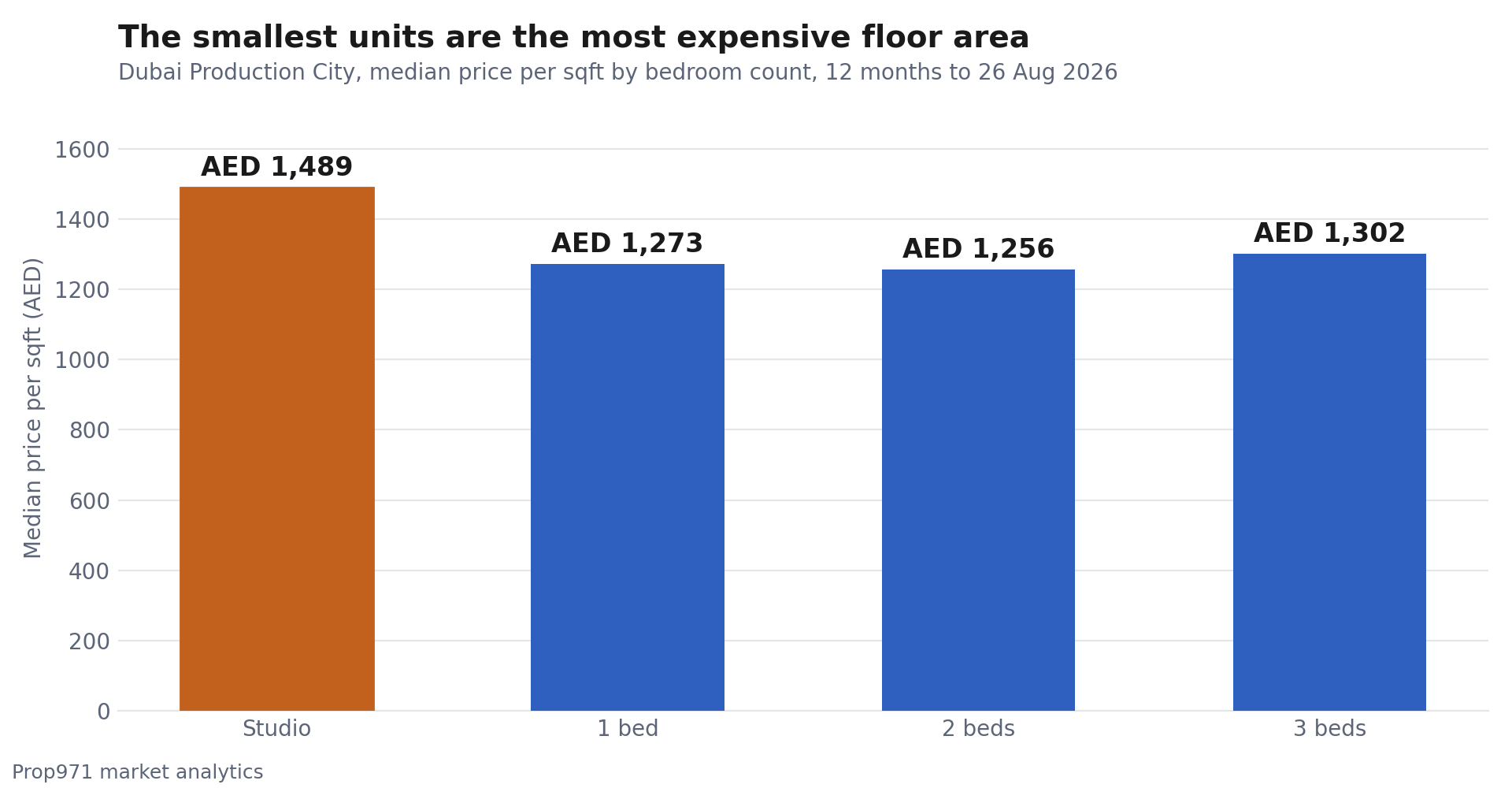
This is normal across the city and not a quirk of the district, but it matters here more than most places because studios were the single largest slice of what sold. If the plan is to buy floor area, the one-bedroom is the better unit of account. If the plan is to buy the lowest possible ticket, the studio wins on the only number that matters to that buyer, which is the total.
How it compares with its neighbours
The district sits in the Sheikh Mohammed Bin Zayed Road corridor alongside several communities of a similar vintage, and they do not price alike.
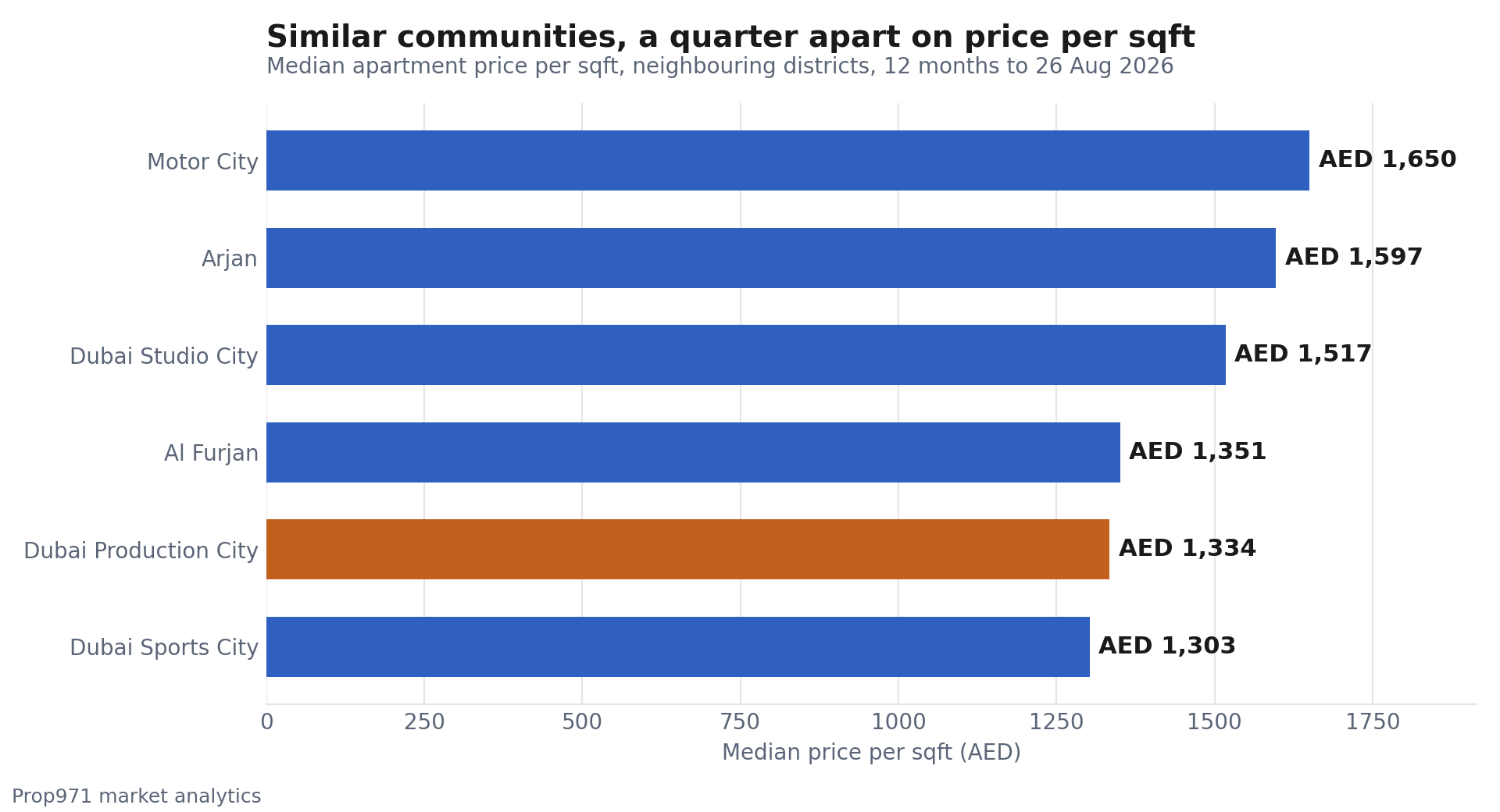
Only one of its immediate neighbours is cheaper per square foot. The rest run between 1% and 24% above it, with the top of that range asking AED 1,650 against this district's AED 1,334.
That spread is the useful part. Communities that a listing site will describe in near-identical language, all reachable from the same interchange, differ by roughly a quarter on the only price that lets you compare a 430 square foot studio with a 1,200 square foot two-bedroom. None of which appears on a brochure, and none of which is fun to assemble by hand, which is why our district and price comparisons sit in one place.
Who the district actually suits
Three groups, on the numbers above.
The budget-constrained resident buyer, who cares about the total and can live with an older building. The finished one-bedroom at AED 600k is genuinely one of the lower entry points into freehold Dubai, and 32% of the district's sales came in under AED 700k.
The yield-minded investor, with a caveat. Smaller units carry the higher per-square-foot cost here, and across Dubai smaller units also carry the higher gross yields, so the studio premium is not automatically a bad trade. It is a trade to check against a specific rent rather than assume, which is what the ROI calculator is for.
The off-plan buyer is the one who should look hardest at the 39%. Paying it can be perfectly rational, for a newer building, a payment plan, or a unit that simply does not exist in the resale stock. Paying it without knowing it is 39% is the part worth avoiding, and there is a whole comparison of off-plan against ready property if that is the live question.
Whichever side of that you land on, check the project is registered and that your instalments go to its escrow account, the regulated account a developer can only draw against construction progress rather than at will. That is verifiable before you sign, through the Dubai Land Department, and it is the single check that most protects the money.
The one thing the numbers cannot tell you is what the district is like to live in. Go at rush hour, and go on a weekend, because the answers differ.
FAQ
How much does an apartment cost in Dubai Production City?
The median apartment sold for AED 950k over the last twelve months, at AED 1,334 per square foot. A quarter of sales came in under AED 659k, and the median finished one-bedroom was AED 600k.
Is Dubai Production City cheaper than the rest of Dubai?
Yes. At AED 1,334 per square foot it sits about 23% below the Dubai-wide apartment median of AED 1,730. Roughly 53% of its sales were under a million dirhams, against 33% across Dubai.
Is Dubai Production City freehold?
Yes, it is a freehold district, so foreign nationals can own property there outright. The ownership rules are the same ones that apply across Dubai's designated freehold areas, set out on the UAE government portal and covered in our guide on whether foreigners can buy property in Dubai.
Should I buy off-plan or resale in Dubai Production City?
Off-plan carried a 39% premium per square foot over finished stock in the last twelve months, wider than the 28% Dubai-wide gap. Resale buys a cheaper, smaller, older unit you can inspect; off-plan buys a newer building and a payment plan. The premium is the price of that choice and is worth knowing before committing.
What was Dubai Production City called before?
It was originally the International Media Production Zone, still widely abbreviated to IMPZ, and a lot of older listings and directions still use that name.
What size are apartments in Dubai Production City?
The median unit sold was 734 square feet. Studios ran a median of 434 square feet, one-bedrooms 802, two-bedrooms 1,221 and three-bedrooms 1,736.
References
Figures in this article are computed from official UAE property transaction records (DLD, ADREC) via Prop971 market analytics, including transactions up to 26 August 2026.


