
A foreign buyer can own a Dubai apartment outright, freehold, with no residency visa, no local partner and no requirement to have ever set foot in the country. That part is settled law and it is genuinely simple. Whether the purchase also comes with residency is a separate question, and for most of the market the answer is no.
This guide covers where foreigners can own, what the ownership actually is, what buyers pay across the city, the fees on top, and how the AED 2 million residency threshold lines up against real Dubai prices.
Key takeaways
- Foreigners can hold full freehold title in designated areas of Dubai, or usufruct and leasehold rights of up to 99 years elsewhere.
- The median Dubai sale was AED 1.31M over the last twelve months, down from about AED 1.38M the year before.
- Only 30% of purchases cleared the AED 2M residency threshold, so the line falls between a one-bedroom and a two-bedroom.
- The 4% transfer fee comes to about AED 52k at that median, and roughly AED 80k on a 2M purchase.
What foreigners are actually allowed to own
Dubai splits land into freehold areas, where foreign nationals can own the property and its land with no time limit, and everywhere else. In the designated zones, a foreign owner has the same rights a UAE national has: sell it, lease it, mortgage it, leave it to someone. Outside them, foreigners can still hold usufruct or leasehold rights for up to 99 years, which is a long lease wearing a formal name.
The official UAE government portal sets out the position across the emirates, and the differences matter more than most buyers expect. Abu Dhabi allows foreign ownership inside nine designated investment areas. Sharjah does not grant ownership to foreign nationals at all, only usufruct rights running up to 100 years.
There is no minimum age and no visa prerequisite. You do not need to be resident, and you do not need to be in the country. What you do need is the money and a passport, which is the part that turns out to be the constraint.
What a Dubai purchase actually costs
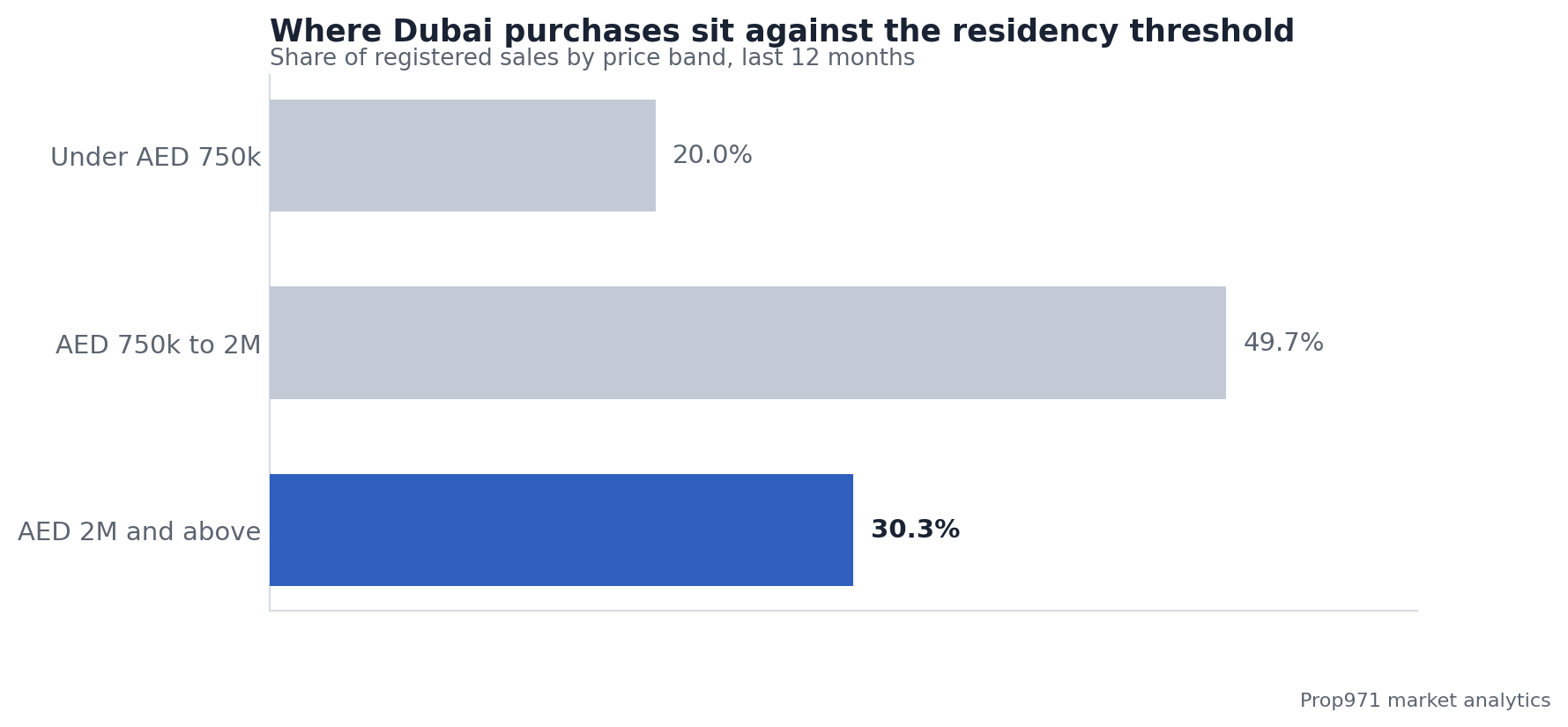
The median Dubai sale over the last twelve months was AED 1.31M, down from about AED 1.38M in the preceding year. Four in five purchases came in above AED 750k. Three in ten came in above AED 2M.
On top of the price sits the transfer fee payable to the Dubai Land Department, which is 4% of the purchase price. At the citywide median that is about AED 52k. On a 2M purchase it is AED 80k. Agency commission is typically another 2% on finished property, and the DLD publishes the trustee and registration charges alongside the transfer schedule.
Those percentages are the reason the buy-side arithmetic in Dubai is unforgiving at the bottom of the market. The fee is charged on the price, not on the equity, so a buyer putting 20% down on a 1.3M apartment pays the same 52k transfer fee as a cash buyer, on a deposit of 260k. Developers know this, which is why fee waivers show up in launch incentives more often than price cuts do. The current crop sits on our offers page.
The residency threshold runs between a one-bed and a two-bed
The property route to a ten-year golden visa asks for AED 2 million. It is measured on the total value of what you own rather than what you have paid so far, and more than one property can be combined to reach it.
Set that number against what Dubai apartments actually sell for and the threshold stops being an abstraction:
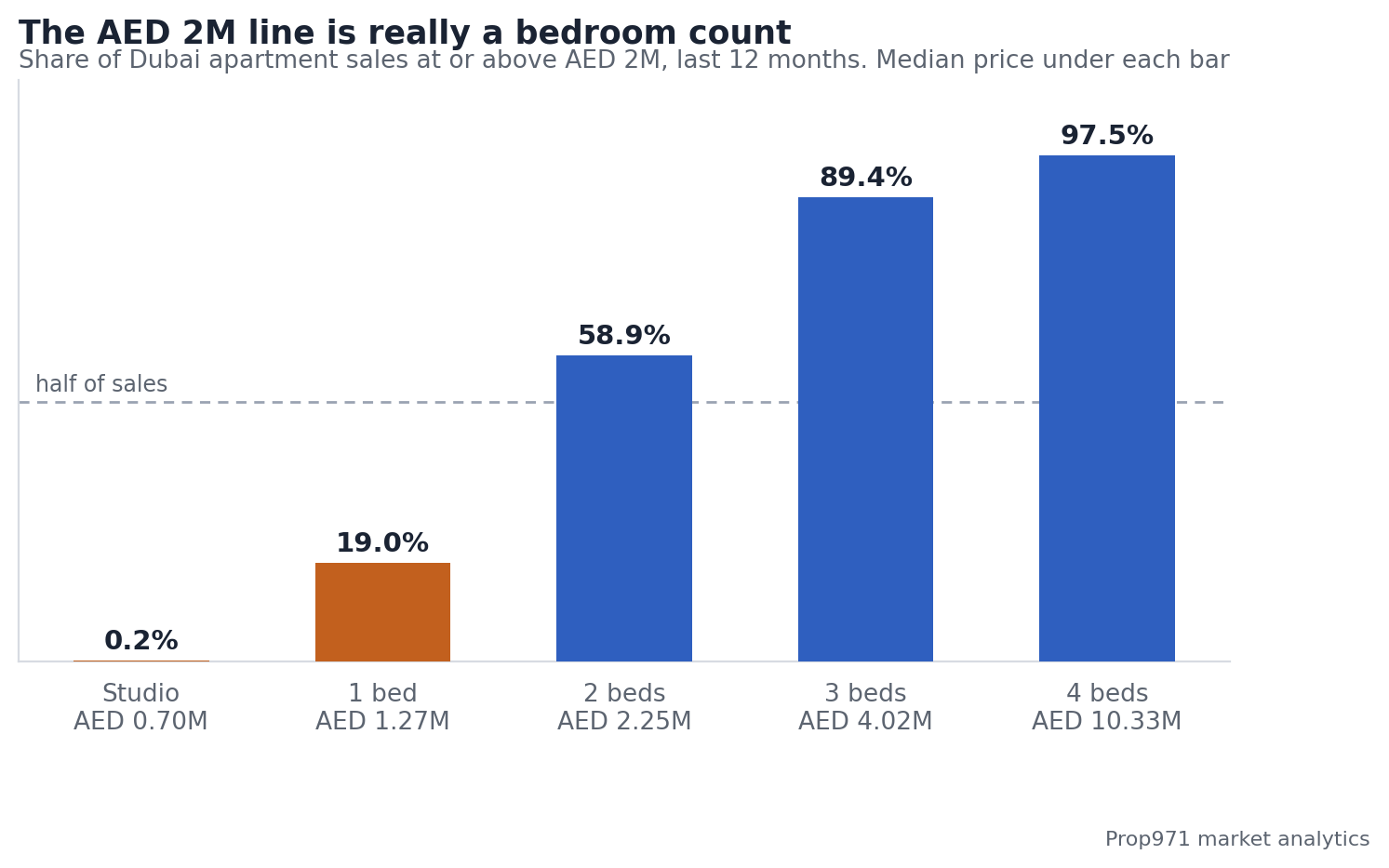
A studio cleared the threshold 0.2% of the time, at a median of AED 700k. A one-bedroom cleared it 19% of the time, median AED 1.27M. A two-bedroom cleared it 58.9% of the time, median AED 2.25M. Above that it stops being a question: 89.4% of three-bedroom purchases cleared 2M, and 97.5% of four-bedroom ones.
So the residency threshold is not really a price. It is a bedroom. The entire policy question of whether a Dubai purchase carries a ten-year visa resolves, for most buyers, into whether they bought one bedroom or two.
The share is also drifting the wrong way for anyone counting on it. Three in ten purchases cleared 2M over the last twelve months, against about a third the year before, because the median price fell while the threshold did not move. Villas are a different market entirely: 93% of villa purchases cleared the line, at a median of AED 3.54M.
Where the threshold is easy and where it is out of reach
Across the 75 Dubai districts with enough registered sales to measure properly, 22 had a median sale above AED 2M. In the other 53, the typical purchase does not reach the threshold, and in a good number of them almost nothing does.
| District | Median sale | Share clearing AED 2M |
|---|---|---|
| Trade Center Second | AED 5.81M | 99.7% |
| Zaabeel Second | AED 3.93M | 98.0% |
| Palm Jumeirah | AED 5.90M | 92.9% |
| Al Wasl | AED 3.28M | 91.7% |
| Palm Deira | AED 2.81M | 89.9% |
| Dubai Studio City | AED 650k | 0.3% |
| Discovery Gardens | AED 745k | 0.2% |
| Al Hebiah Second | AED 736k | 0.0% |
| International City Phase 1 | AED 475k | 0.0% |
| Al Warsan First | AED 420k | 0.0% |
The spread runs from districts where essentially every sale clears the threshold to districts where, over a full year of transactions, essentially none did. A buyer with AED 2M to place can pick almost any address in the city. A buyer with AED 800k can pick any address they like too, and will not be getting a golden visa in any of them.
None of that appears on a brochure, and no listing tells you what the district around it typically sells for. That comparison is the one thing a buyer needs before choosing where to look and the one thing nobody publishes next to the price, which is why our analytics dashboard recomputes district medians from every registered sale, and why our guide to the cheapest areas to buy in Dubai works through the bottom of that range district by district.
Abu Dhabi changes the arithmetic
The residency rule is federal. The prices are not, and the same AED 2M threshold behaves completely differently one emirate over.
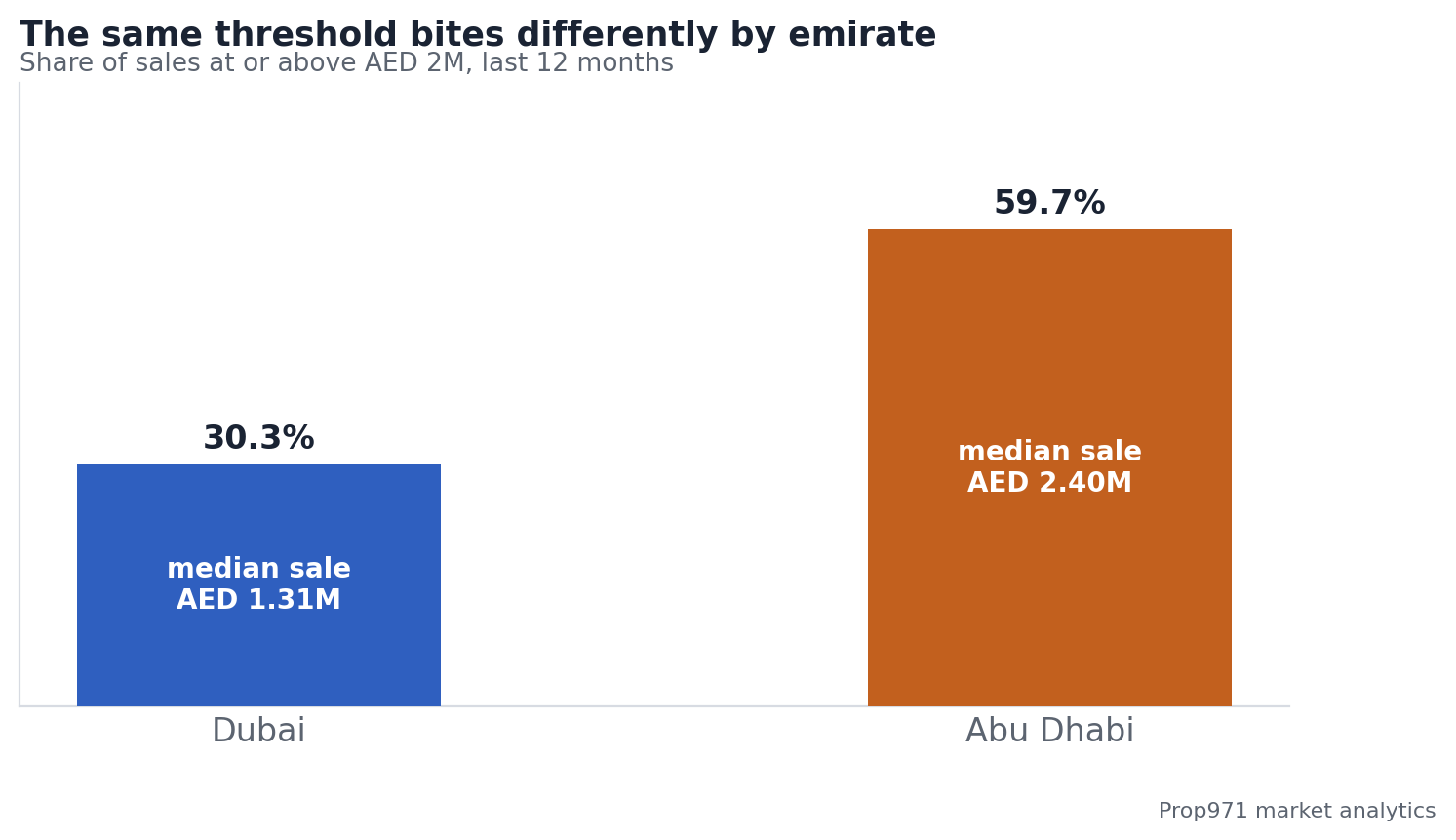
The median Abu Dhabi purchase was AED 2.4M, comfortably above the line, and 59.7% of purchases cleared 2M against Dubai's 30.3%. The transfer fee is lower too: 2% registered with ADREC, against Dubai's 4%. On a 2M purchase that is AED 40k of difference before either property does anything at all.
The trade is liquidity. Dubai turns over far more stock, so exit is easier and comparable sales are denser. Our guide to off-plan projects in Abu Dhabi covers how the emirate's escrow rules protect instalments during construction.
What to check before committing
If you are buying off-plan, your money goes into a project escrow account rather than to the developer directly, and the registration is an Oqood, an interim registration with the DLD that converts to a title deed at handover. Verify the escrow account exists and that the project is registered before any payment leaves your hands. This is the one part of the process where being wrong is expensive and slow to unwind.
For a finished purchase, the all-in figure is the price plus 4%, plus commission, plus the trustee and registration charges. That number moves with the emirate, with whether the property is off-plan or finished, and with what your developer charges for admin, which is a calculation people build once in a spreadsheet and never update. Ours holds the UAE defaults with every input editable, in the ROI calculator.
FAQ
Can foreigners buy property in Dubai without residency?
Yes. Foreign nationals can buy freehold property in Dubai's designated areas with no residency visa, no local sponsor and no requirement to be in the country. A valid passport is what the purchase runs on, and ownership rights inside a freehold area are the same as those held by UAE nationals.
What is freehold property in Dubai?
Freehold means you own the unit and its share of the land outright, with no time limit, and you can sell, lease, mortgage or bequeath it. It applies only inside government-designated freehold areas. Outside them, foreign buyers can hold usufruct or leasehold rights of up to 99 years instead, which is a long lease rather than ownership.
How much is the DLD fee when buying property in Dubai?
The Dubai Land Department transfer fee is 4% of the purchase price, roughly AED 52k at the citywide median sale of AED 1.31M and AED 80k on a AED 2M purchase. Trustee and registration charges sit on top, and agency commission is typically another 2% on finished property.
Does buying property in Dubai get you a golden visa?
Only above AED 2 million in total property value, which most purchases do not reach. About 30% of Dubai purchases cleared that threshold over the last twelve months. More than one property can be combined to reach the total, and the value is assessed on the property rather than on how much of it you have paid off.
Which Dubai areas are freehold for foreigners?
Freehold zones are set by regulation and cover most of the areas international buyers already look at, including the waterfront districts and the newer master communities. Ownership type is recorded against the specific plot, so confirm the designation for the individual property with the Dubai Land Department before committing rather than relying on the area's reputation.
References
Figures in this article are computed from official UAE property transaction records (DLD, ADREC) via Prop971 market analytics, including transactions up to 19 August 2026.


