
Off-plan property in Dubai is not the cheap option. It costs 29% more per square foot than finished stock.
That is the opposite of what the pitch usually implies. Buying off plan in Dubai is sold on a discount today for patience later, and three quarters of the market is buying it. Over the last twelve months Dubai apartments sold before completion went through at a median of AED 1,800 per square foot, against AED 1,392 for completed ones. Abu Dhabi is wider still.
The gap is real. What it means for the flat in front of you is a different question, and this is where most of the advice stops.
Off-plan trades above ready stock, in both emirates
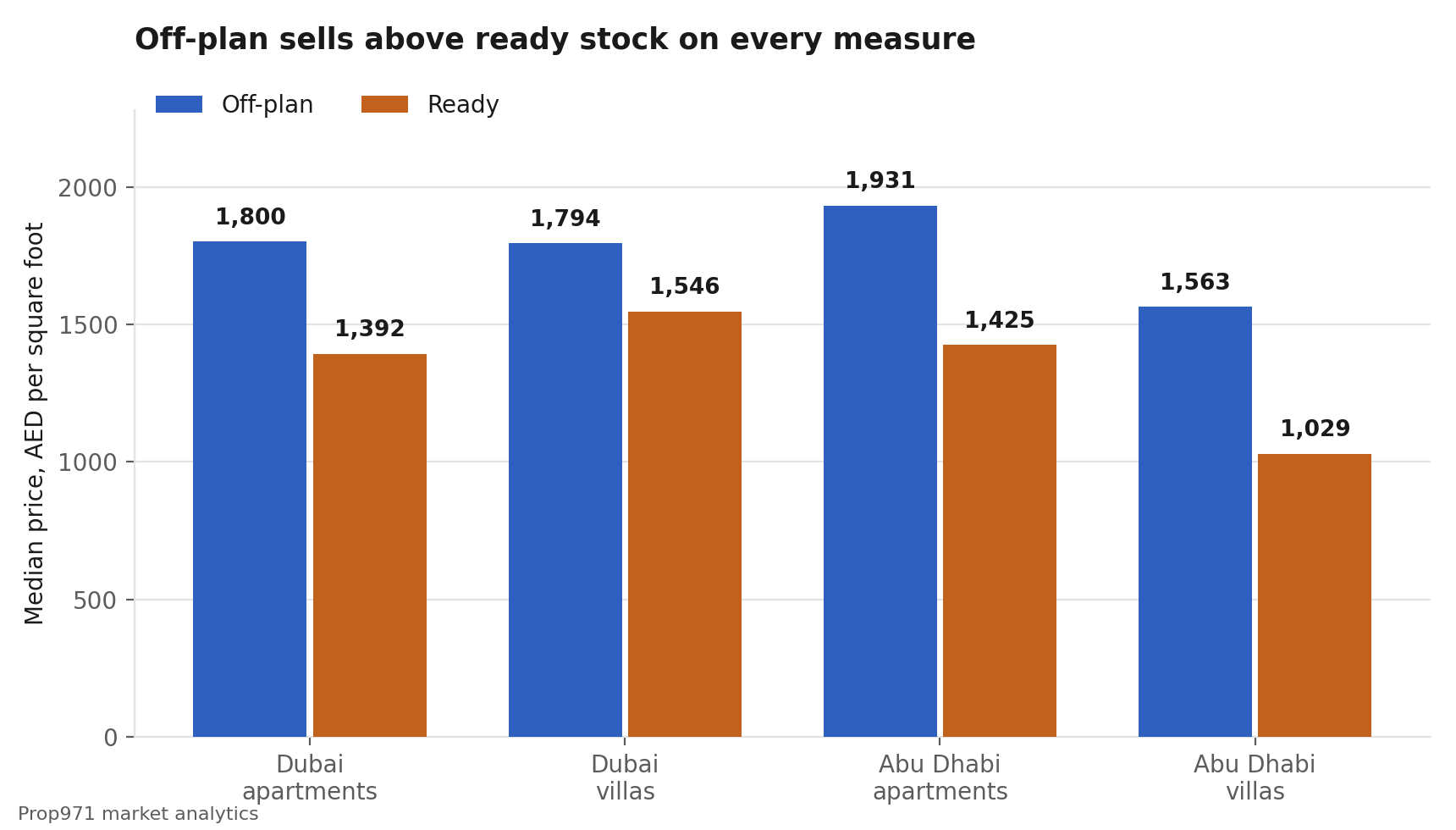
Every one of the four comparisons runs the same way.
| Segment | Off-plan, per sq ft | Ready, per sq ft | Premium | Sales compared |
|---|---|---|---|---|
| Dubai apartments | AED 1,800 | AED 1,392 | +29% | 149,640 |
| Dubai villas | AED 1,794 | AED 1,546 | +16% | 7,772 |
| Abu Dhabi apartments | AED 1,931 | AED 1,425 | +35% | 20,352 |
| Abu Dhabi villas | AED 1,563 | AED 1,029 | +52% | 5,882 |
Median price per square foot, last 12 months. Off-plan means sold before completion.
Dubai apartments carry a 29% premium, Dubai villas 16%. Abu Dhabi apartments carry 35% and Abu Dhabi villas 52%, the widest gap in either emirate.
The total ticket moves the same way, in case per-square-foot feels abstract. The median Dubai off-plan apartment sold for AED 1.29M against AED 1.12M for a ready one, and it was smaller: 762 square feet against 834. You are paying more, for less floor, for something that does not exist yet.
Three quarters of the market is buying the dearer option
Off-plan was 76% of Dubai residential sales over the last twelve months, up from 72% the year before. In Abu Dhabi it was 80%, up from 65%.
Those buyers are not making a mistake, and it is worth being precise about why. An off-plan purchase buys a payment plan, a new building, a warranty and two or three years before the money is fully due. Ready stock in the same district is often a decade older. The premium is the price of those things bundled together.
The mistake is treating the headline number as a fact about your purchase.
The premium is a local number, not a market number
Across 45 Dubai districts with a real sample on both sides, the median premium was 41%. The range was -3% to +107%.
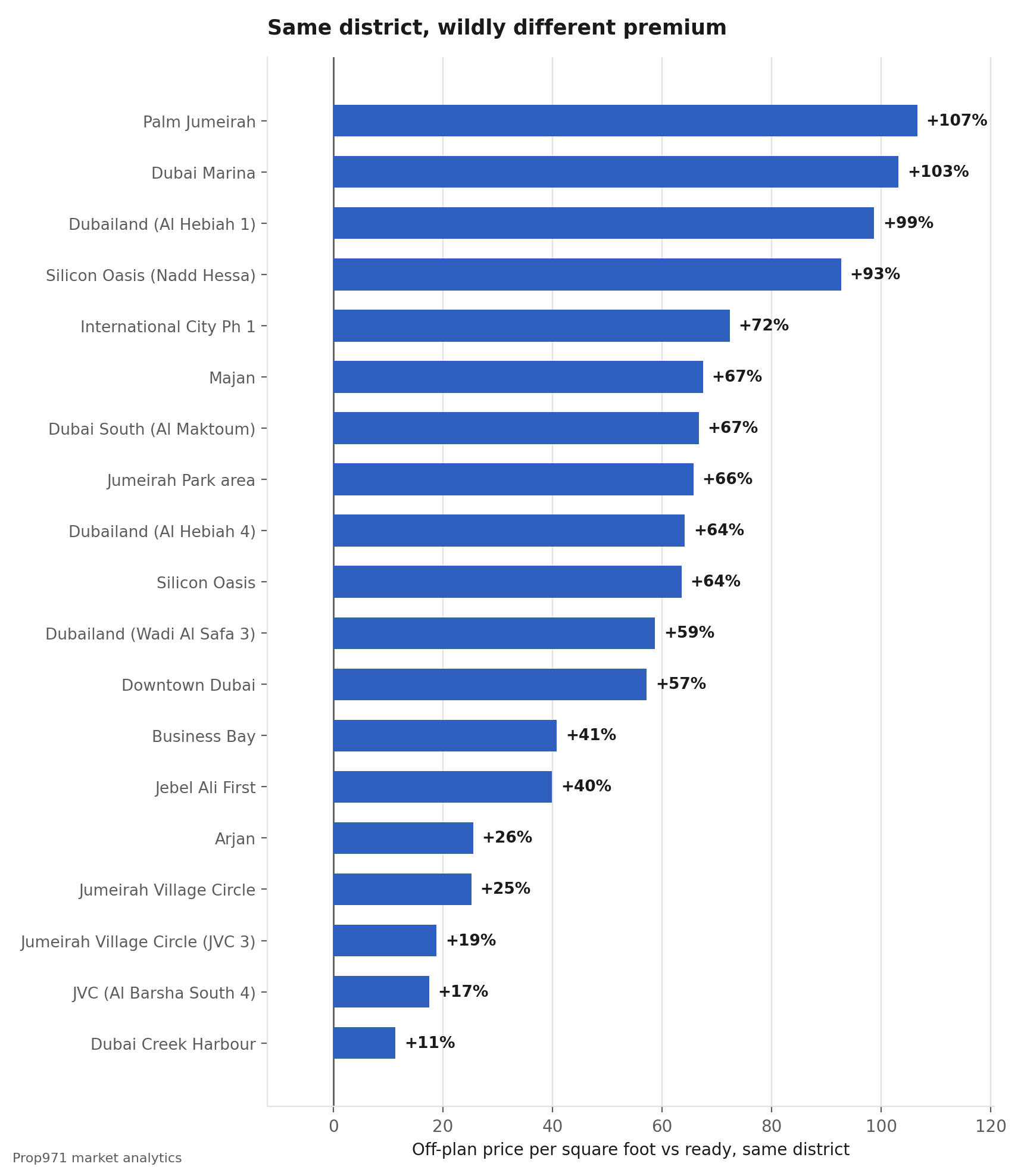
At the bottom, off-plan and ready sell for roughly the same money. In Umm Suqeim off-plan was 2.7% cheaper. In Dubai Creek Harbour the premium was 11%, in Jumeirah Village Circle 25%.
At the top it doubles. Palm Jumeirah showed +107%, Dubai Marina +103%. In both, the ready stock includes buildings from the 2000s and the off-plan is a handful of new waterfront towers. That is not one product at two prices. It is two products.
So "off-plan costs about 30% more" is true of Dubai and useless in a district. Anyone quoting you a market-wide premium is quoting a number that is wrong almost everywhere.
Compare one bedroom count and the gap moves, both ways
The obvious objection is mix. Off-plan skews to different unit sizes than ready stock, so some of the gap is the blend rather than the price.
Comparing only two-bedroom apartments inside the same district tests that, and the result is not tidy.
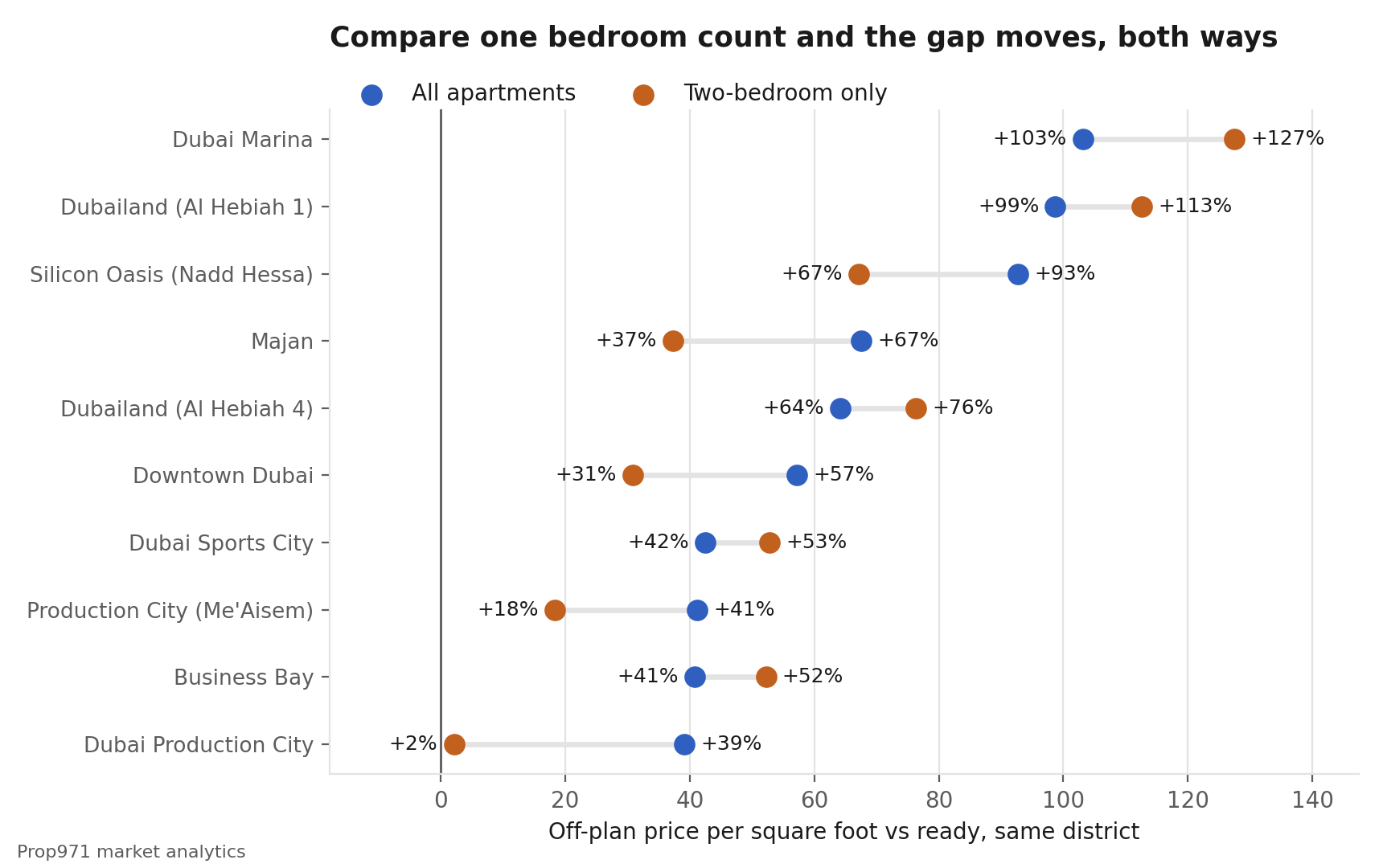
In Dubai Production City the premium falls from 39% to 2%. In Majan it falls from 67% to 37%, in Downtown Dubai from 57% to 31%. The gap was mostly mix.
Then it goes the other way. In Dubai Marina the premium rises from 103% to 128%, in Business Bay from 41% to 52%, in Dubai Sports City from 42% to 53%. Controlling for the bedroom count made off-plan look more expensive, not less.
Both results are the same lesson. The premium you are being asked to pay is a property of one district and one unit type, and there is no shortcut from the market number to your number.
The gap is narrowing while more people pay it
Year on year, both emirates moved the same direction. The Dubai apartment premium came in from 37% to 29%. Abu Dhabi came in from 59% to 35%.
Ready prices rose into the gap while off-plan pricing held roughly flat, which is what a maturing market looks like. Volume went the other way: the off-plan share rose in both emirates while its premium shrank.
Dubai villas are the exception and deserve a caveat rather than a headline. The villa premium widened from 1% to 16% on a much smaller sample, and villa off-plan volume halved over the same period. That is a mix story waiting to be told properly, not a finding.
Abu Dhabi runs its own version, and two districts run backwards
Abu Dhabi has fewer districts with enough depth to compare, six in total, and two of them invert.
In Khalifa City off-plan sold 16% below ready stock. On Al Maryah Island it sold 8% below. Elsewhere the premium was 21% on Yas Island, 25% in Al Raha and 31% on Al Reem Island. Saadiyat Island showed +104%, on a thin resale sample against a wave of new waterfront launches, so treat it as a mix effect rather than a price.
If you are looking at off-plan projects in Abu Dhabi, the practical consequence is that the direction of the gap is not settled the way it is in Dubai. Two of six districts pay you to buy new.
How to check the premium on the unit in front of you
The test is short, and none of it needs a broker.
1. Fix the district. Not the emirate, not "Dubai". District medians for the same month differ by more than the off-plan premium itself.
2. Fix the bedroom count. As above, this moves the answer by tens of percentage points in both directions.
3. Work in price per square foot, never total price. Off-plan units are smaller in Dubai, so totals flatter them.
4. Ask what the ready comparison actually is. If the resale stock in that district is fifteen years old, a large premium is buying a newer building, not a worse deal.
5. Then judge the payment plan separately. Paying 40% over three years is genuinely different from paying it now, and it is a financing question, not a pricing one.
Steps one to three are where this normally falls apart, because a portal listing gives you an asking price and no comparison. That is the gap our market analytics is built for: same district, same bedroom count, actual transacted prices rather than asking prices, so the premium you are quoted can be checked against the premium the district is paying. Where a specific project is concerned, our project comparison puts two of them side by side on the same measures.
Off-plan property investment can be a good buy at a 40% premium and a bad one at 10%. The number on its own settles nothing. The comparison does.
FAQ
Is off-plan property cheaper than ready property in Dubai?
No. Over the last twelve months, off-plan apartments in Dubai sold at a median of AED 1,800 per square foot against AED 1,392 for ready apartments, a premium of 29%. Villas showed a 16% premium. Off-plan is the more expensive option per square foot in both emirates and in almost every district.
Why is off-plan more expensive if it is not finished?
The price includes things the ready comparison does not have: a new building, a payment plan spread over the construction period, a developer warranty, and current specification. Ready stock in the same district is often ten to fifteen years older. In districts where the ready stock is also new, such as Dubai Creek Harbour, the premium falls to around 11%.
How much premium should I expect to pay for off-plan in Dubai?
There is no single figure worth carrying around. Across 45 Dubai districts the median premium was 41%, but the range ran from 3% below ready stock in Umm Suqeim to 107% above it on Palm Jumeirah. Check the district and the bedroom count you are actually buying.
Is buying off plan in Abu Dhabi different from Dubai?
The premium is wider on the emirate level, 35% for apartments and 52% for villas, but the district picture is less settled. Of the six Abu Dhabi districts with enough transactions to compare, two showed off-plan selling below ready stock: Khalifa City at 16% below and Al Maryah Island at 8% below.
Is the off-plan premium getting bigger or smaller?
Smaller. The Dubai apartment premium narrowed from 37% to 29% year on year, and the Abu Dhabi apartment premium from 59% to 35%. Over the same period the off-plan share of sales rose in both emirates, to 76% in Dubai and 80% in Abu Dhabi.
References
Figures in this article are computed from official UAE property
transaction records (DLD, ADREC) via Prop971 market analytics,
including transactions up to 6 September 2026.


